The Limits of Language & Logic – Part 2
Part 2: continuing the exploration of the limits of language & logic.
Continued from Part 1.
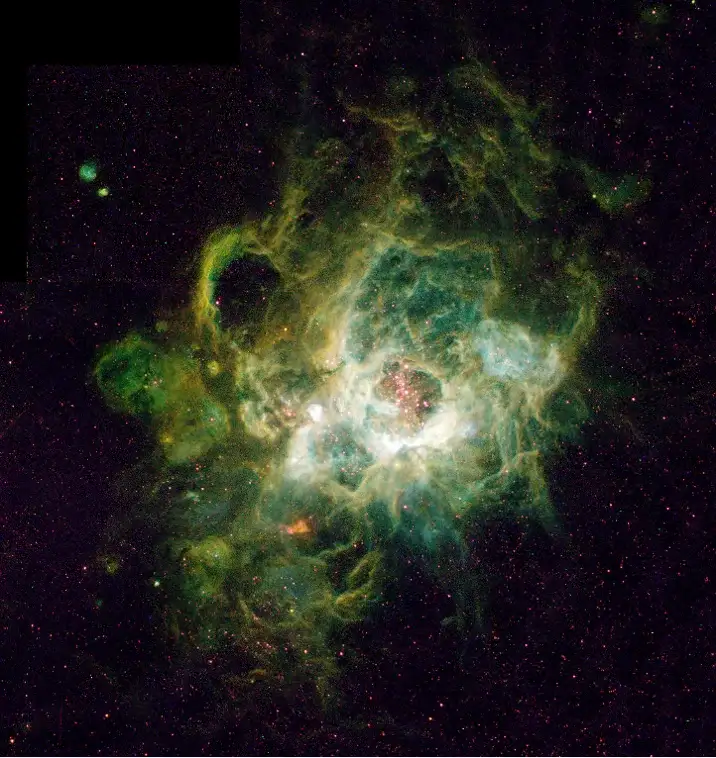
Hui Yang (University of Illinois), NASA, 1995.
“O Deep Thought computer,” he said, “the task we have designed you to perform is this. We want you to tell us…” he paused, “The Answer!” “The Answer?” said Deep Thought. “The Answer to what?” “Life!” urged Fook. “The Universe!” said Lunkwill. “Everything!” they said in chorus. Deep Thought paused for a moment’s reflection. “Tricky,” he said finally. “But can you do it?” Again, a significant pause. “Yes,” said Deep Thought, “I can do it.” “There is an answer?” “Yes,” said Deep Thought. “But,” he added, “I’ll have to think about it.”1 (Douglas Adams)
``
Logic is just another language, with all the problems that arise when we mistake usefulness and consistency for the deeper truths about reality.
Gödel’s Incompleteness #
Since 1900 mathematicians had asked whether mathematics is internally complete and self-evident: can every true statement be proved from the axioms, or will some assumption from outside always be needed?
“Human understanding and insight cannot be reduced to any set of computational rules … Gödel appears to have shown that no such system of rules can ever be sufficient to prove even those propositions of arithmetic whose truth is accessible, in principle, to human intuition and insight.”2 (Roger Penrose)
In 1931 Kurt Gödel answered the question for any formal system powerful enough to express arithmetic. His two theorems, informally:
- Incompleteness. If the system is consistent, there are true statements about the natural numbers that it cannot prove. Add those statements as new axioms and new unprovable truths appear.
- Unprovable consistency. If the system is consistent, it cannot prove its own consistency. A system cannot vouch for itself from the inside.
``
The trade-off is between consistency (never proving a contradiction) and completeness (proving every truth): for sufficiently powerful systems you cannot have both.
A cousin of the idea is the liar paradox. “This statement is not true” cannot be consistently assigned either truth value: if true it is false, if false it is true. Gödel’s achievement was to build, inside arithmetic itself, a statement G that says in effect “this statement is not provable in this system”. If the system is consistent, G cannot be proved — and is therefore true. There are truths the system can state but never reach.
“If I were to tell you that the next thing I say would be true, but the last thing I said was a lie, would you believe me?” (Doctor Who)
Turing’s Halting Problem #
Any algorithm, human or mechanical, breaks a task into discrete steps. Some tasks never finish. The decimal expansion of π never terminates and never repeats — π is irrational and indeed transcendental — so a program asked for its last digit will run until the end of the universe. We know that in advance, so we never ask; we ask for the thousand-trillionth digit instead, which a sufficiently powerful computer can supply.
``
The difficulty is that for many problems in mathematics and physics we do not know in advance whether a computation will finish. It would be wonderful to have a program that could tell us. In 1936 Alan Turing proved that no such program can exist.3
The proof is by contradiction. Suppose a Halt Program (HP) exists that, given any program and any input, always stops and correctly reports “halts” or “runs forever”. Now build a mischievous program, Tricksy, that asks HP about itself and does the opposite: if HP says “halts”, Tricksy loops forever; if HP says “runs forever”, Tricksy halts. Feed Tricksy to HP. Whatever HP answers is wrong. So HP cannot exist.
Apollo, the magical predictor #
I find the halting proof hard to hold in the mind — I am only a bear of little brain — so here is a modern analogy.
Imagine an AI, Apollo, with the magical power to predict any statement another player will make. Apollo wins if its prediction is correct; predictions and statements go separately to a trusted referee, Nakamoto. Now let Apollo play against a copy of itself.
Apollo 1 predicts what Apollo 2 will send. But Apollo 2 can foresee that prediction and change its message before sending. Apollo 1 foresees the change and adjusts. Apollo 2 foresees the adjustment and changes again. The loop runs until the electricity is turned off, and poor Nakamoto never receives a message. Nor can Apollo 1 win by predicting that Apollo 2 will send nothing, because Apollo 2 would foresee that and send something arbitrary — which Apollo 1 would foresee, and so on.
Add time limits or force one Apollo to go first and the result is the same: if Nakamoto receives a wrong prediction from Apollo 1, Apollo 1 is not a perfect predictor; if Nakamoto receives a right one, Apollo 2 failed to predict it. However magical the predictor, it cannot predict its own prediction. That is the shape of Turing’s result, and of Gödel’s.
Note that undecidable problems are different from merely intractable ones, which have solutions but need vast resources. The related P versus NP question asks whether every problem whose answer can be checked quickly can also be solved quickly.4 Cryptography rests on the assumption that it cannot — that verifying is easier than solving.
“As far as the laws of mathematics refer to reality, they are not certain; and as far as they are certain, they do not refer to reality.”5 (Albert Einstein)
Logic, Entropy and the Cost of Knowing #
Real knowledge requires work. Algorithms find shortcuts, but they cannot abolish work altogether. If we could learn the answers to the universe’s questions without doing any, there would be no indeterminacy and no information entropy; we could cheat the universe of its secrets. A universe like that would have no need of intelligent life. Intelligence would be wasteful in it.
Life arises in the interplay between positive information (changing but knowable facts) and negative capability (the statistical freedom to deviate). If everything were predetermined and knowable in advance, there would be no need for deviation, intelligence included. Deviancy is an elegant algorithm for a world in which it is impossible to know all the facts, or which solutions will prove best, without working each problem through.
“But an inner voice tells me that it is not yet the real thing. The theory says a lot, but it does not really bring us any closer to the secrets of the Old One. I, at any rate, am convinced that He does not play dice.”6 (Albert Einstein)
I side with Einstein, but I prefer a card game. The universe is the dealer of hands from a very large pack. It may know every hand, but its rules ensure that each player plays only with the cards they hold and the cards they see dealt. A thoroughly shuffled deck that happens to deal 26 red cards and then 26 black is astronomically improbable — about 1 in 496 trillion — and once the 26th red card falls, the colour of every remaining card is certain. That shift from near-total uncertainty to zero uncertainty is the simplest picture of entropy in information terms; it is developed in What is Entropy? Part 1.
Perhaps probability is central to our two strongest theories — quantum mechanics and thermodynamics — because that is how the universe avoids determinism: not by chance, but by probabilistic outcome. If so, the same truth must appear in every field of action and information. It is the basis of ethics, evolution, freedom, logic, entropy, information theory and cryptography. Life and intelligence live in the gap between causality and chaos, between usable energy and uncertainty.
Recognising undecidability is not the same as saying the universe is random. We can answer many questions, at a cost. The work required for a solution is how the universe keeps every participant honest and denies any life-form an absolute vantage point, which is God’s or nature’s sole preserve. The uncountable microstates of matter and information are the means, and that is why every attempt to quantify them completely must fail.
“Every macroscopic system and its surroundings are characterized by probability distributions of microstates.”7 (David Layzer)
We should be careful, too, about which questions can be asked, and which cannot be answered in binary terms or with signs at all. Perhaps, as the ancient scientist Gautama Buddha found, the deepest questions require signless silence.
Seven and a half million years later… “Forty-two,” said Deep Thought, with infinite majesty and calm. … “I checked it very thoroughly,” said the computer, “and that quite definitely is the answer. I think the problem, to be quite honest with you, is that you’ve never actually known what the question is.”8 (Douglas Adams)
Non-Duality #
The multiplicity of reality calls for theories and ethical frameworks that foster the greatest structurally sound diversity of views. In Ethics of Life I proposed an experimental framework for justifiable relative ethical decisions within the constraints required for the whole system to function — compossibility.
A Newton disc shows how colour is made of a unitary whiteness. It may seem ironic that a framework founded on universality should propose maximal relativism. But if the invariant truth is the white light — the life energy — and the degrees of ethical freedom are the colours on the wheel — the actions of life-forms — the apparent contradiction dissolves. See Towards a universal ethical framework.
Many of the contradictions that trouble us arise from a strongly dualistic habit in Western culture, especially in over-simplified monotheism. Non-dualism teaches that the multiplicity of the universe reduces to one essential reality — and that non-dualism needs its apparent opposite. When every perspective is allowed its use, together they come closer to the ineffable.
Einstein’s equivalence of matter and energy is powerful because it sees through appearances to an underlying unity, where Western thought has tended to divide: most damagingly in the Cartesian separation of mind and body. Let us not beat about the burning bush. That separation has been used to call one part holy and the other evil, and has licensed unspeakable cruelty by supposedly sapient beings. In the long history of teaching love and compassion, it may be the greatest error of thought, and the greatest sin, within Western religion.
You do not have to be good. You do not have to walk on your knees for a hundred miles through the desert, repenting. You only have to let the soft animal of your body love what it loves.9 (Mary Oliver)
In Buddhism non-duality is bound up with emptiness (śūnyatā); in Taoism with yin and yang, which include and define one another, and together express a oneness that is still bounded by the greater space around it. There is no way to quantify what is boundless. Both oneness and duality are provisional; true non-duality is beyond oneness. Even non-dualism is a raft to be left on the far shore.
A sphere withstands great pressure because it distributes force across its whole boundary; it is nature’s strongest shape. The formal likeness of a circle to a zero is probably accidental, yet it is pleasing that wholeness and emptiness mirror one another in their form.
Underneath the appearance of things — time and space, energy and matter, order and chaos, knowledge and entropy — there is a unity of duality: zeros and ones, emptiness and fullness. Some cosmologies point the same way, imagining this epoch ending in a collapse to a singularity before a new one begins, or a fractal multiverse in which every black hole seeds another universe. The current evidence favours continued expansion, but the thought stands: ends are also beginnings.
Artificial general intelligence will need to think non-dualistically: to hold a multiplicity of valid perspectives where the matter is not a universal law, and to see through apparent complexity to the simpler core using logic, imagination, visualisation, poetry and philosophy. Surveying vast probability spaces lets AI winnow toward where answers may hide, and it may find new ones by not sharing human assumptions. But reaching understanding at the end of such a survey is not itself merely probabilistic.
“My aim in philosophy is to show the fly the way out of the fly-bottle.”10(Wittgenstein)
The Limits of Language #
Words strain, Crack and sometimes break, under the burden, Under the tension, slip, slide, perish, Decay with imprecision, will not stay in place, Will not stay still.11 (T. S. Eliot)
Language has its own incompleteness problem, and parts of the recent analytic tradition have been damaging to philosophy and ethics for ignoring it — a regression to a time before the Buddha’s understanding. Every use of language presupposes or implies far more than the word contains. “Table” suggests legs (though not everything with legs is a table), and with them chairs, and eventually everything that is not table. It brings wood and carpentry, craft and trees, clouds and weather, the water cycle, hydrogen and oxygen, stars, energy, entropy and gravity. And so on, indefinitely.
“The dependent origination doctrine highlights the Buddhist notion that all apparently substantial entities within the world are in fact wrongly perceived. We live under the illusion that terms such as ‘I’, self, mountain, tree, etc. denote permanent and stable things … there is fundamental emptiness in all phenomena and experiences.”12(Pratītyasamutpāda)
The word “table” needs the concept “table”, and both need an intelligent life-form raised from the clay by billions of years of evolution. Language can be useful, but it cannot be true in the deepest sense; it can only approach truth. There is no “tableness” in reality, only a more or less useful construct. A set containing infinitely many tables is meaningless if there cannot be infinitely many of any real thing. That does not invalidate boundlessness — but it does remind us that our abstractions are tools.
No reader supposes that their name contains their genes, experiences, culture, desires, sufferings and hopes. A name is not a successful compression of a person; it is an extraordinary abstraction, like defining humans by colour, class, race or gender. Language is algorithmically efficient as a whole, but each word on its own is not. Subconsciously we hold words in a space where they attract, repel and coordinate to make a meaningful pattern.
“I’ve seen Plato’s cups and table, but not his cupness and tableness.” (Diogenes)
Abstractions like tableness are hard for computers and easy for children, who intuit the quality without seeing many tables first — the reverse of how machines have learned. Our ability to believe in abstractions is a blessing and a curse. It is enormously useful; it also lets us mistake useful fictions — religion, race, nation, money — for reality, and so licenses horrors against others, the delusion of strong free will, and the belief that we are separate from, rather than interdependent with, the rest of life on this planet.
We need to come back down to Earth and understand our place as one part of it, not above it.
Plato’s Socrates compared the philosopher to a prisoner freed from the cave who learns that the shadows on the wall are not reality.13 Aristotle disagreed: tableness and treeness belong to each actual table and tree, which are not imperfect projections of an ideal but members of the set of all real tables and trees, past, present and future. The abstraction is one of usefulness, not truth.
Spinoza took the question of forms and the energy from which they arise to a higher level. Individual bodies sharing the same essential attributes are not separate but modes of one substance, differing only in extension. Each has an essence — its persistence of form, its inertia against destruction, which costs energy to maintain. Ultimate reality — God, or the nature of things — is a self-caused substance manifesting in infinite attributes. Things and the ideas of things run in parallel causal streams, but they are attributes of the same underlying reality. Spinoza, too, was a sceptic about free will.
Language is a communal tool that compresses heavily and loses fidelity when it reaches for the ineffable — a kind of inverse holographic principle. It requires great care from the sender, given all that is implied but unsaid, and heavy unpacking by the receiver. That difficulty has been one of the central challenges for natural-language AI, and the transformer architecture has been key to progress.
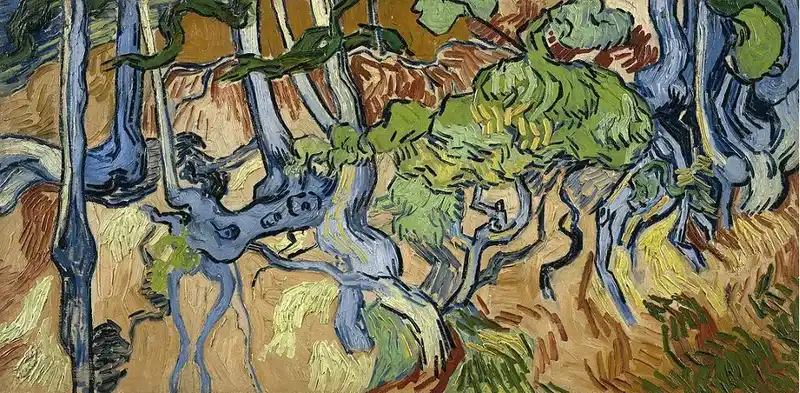
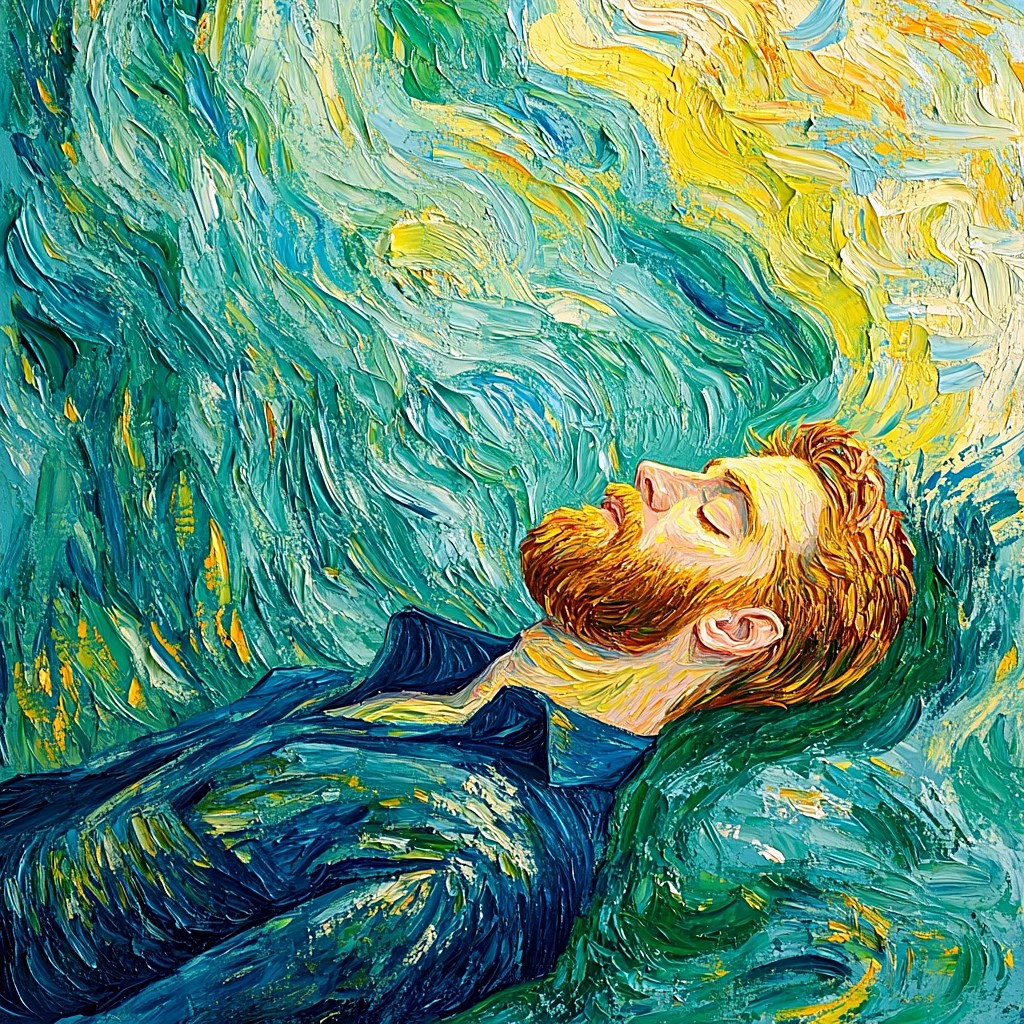
My favourite painter is Van Gogh. He was an extraordinarily compassionate artist, with no interest in a flat, lower-dimensional picture of a tree that we could see better with our own eyes. He was trying to help us glimpse the life force that animates the tree and every other living thing — invisible energy and visible form together — his brushstrokes, rich and heavy, conjuring the hidden life into being. Van Gogh learned the language of trees, and it has no words. It takes a kind of magic. That is why great artists, scientists and holy people can seem like beings from outer space, or from the future.
We have lost sight of what technology means — technē, art, skill, cunning of hand, and logos, to speak of — and assume it applies only to machines. Technology is any cultural practice and collective skill that lets us understand the nature of things more clearly, do useful things and avoid bad ones. We have forgotten to respect, maintain and evolve our technology of the mind.
“We all know that Art is not truth. Art is a lie that makes us realize truth, at least the truth that is given us to understand. The artist must know the manner whereby to convince others of the truthfulness of his lies.”14 (Pablo Picasso)
We cannot compress the universe’s inexpressible reality into words, numbers or pictures without losing much of the meaning, or confusing the expression with what it expresses. Of all our cultural technologies — none of which we invented — music comes closest to the ineffable; some mathematicians say the same of mathematics. Perhaps it is the abstract mathematical nature of harmony, the precise relations between frequencies, joined to the emotion of sounds made by imperfect vessels. Perhaps it is the absence of a separate encoding and decoding step: music feels like communication without loss between composer, singer and listener, though it too is only a more or less useful finite representation of the unsayable.
only silence and music can delve into the abyss and return unscathed yet try we must again again and again15 (Peter Pink-Howitt)
Poetry can also squint at that higher reality, with its pregnant possibilities, uncertainties and seeming contradictions. Paradoxically, poetry groks and speaks the unspeakable.
and I made my own way, deciphering that fire, and I wrote the first faint line, faint, without substance, pure nonsense, pure wisdom of someone who knows nothing, and suddenly I saw the heavens unfastened and open16 (Pablo Neruda)
Footnotes #
Douglas Adams, The Hitchhiker’s Guide to the Galaxy (1979; radio series 1978). ↩︎
Roger Penrose, Shadows of the Mind (1994). ↩︎
Alan Turing, “On Computable Numbers, with an Application to the Entscheidungsproblem” (1936). ↩︎
Matt Parker, “Win a million dollars with maths, No. 2: the P v NP problem”. ↩︎
Albert Einstein, “Geometry and Experience” (1921). ↩︎
Albert Einstein, letter to Max Born (1926). ↩︎
David Layzer, “Cosmology, initial conditions, and the measurement problem” (2010). ↩︎
Douglas Adams, The Hitchhiker’s Guide to the Galaxy (1979). ↩︎
Mary Oliver, “Wild Geese”, from Dream Work (1986). ↩︎
Ludwig Wittgenstein, Philosophical Investigations (1953), §309. ↩︎
T. S. Eliot, “Burnt Norton”, Four Quartets (1941). ↩︎
Wikipedia, “Pratītyasamutpāda”. ↩︎
Plato, Republic, Book VII; Wikipedia, “Allegory of the Cave”. ↩︎
Pablo Picasso, “Picasso Speaks”, The Arts (1923). ↩︎
Peter Pink-Howitt, “Some Solace”. ↩︎
Pablo Neruda, “Poetry”, Selected Poems, trans. Anthony Kerrigan (1993). ↩︎