Towards a universal ethical framework
Freedom is diversity – the ability to be different
AI Podcasts #
Introduction #
“At this stage of history … either the general population will take control of its own destiny and will concern itself with community-interests, guided by values of solidarity and sympathy and concern for others; or … there will be no destiny for anyone to control.”1 (Noam Chomsky)
Be noble, helpful and good! Because that alone distinguishes him Of all beings whom we know … Hail the unknown higher beings of our belief! That we should be like them! Their examples teach us That we might believe in them. Because nature is insensitive: The sun is shining on bad and good, The moon and the stars shine on the evil as on the best of us … As the eternal great iron law requires We must all complete the cycle of our existence.2 (Johann Wolfgang von Goethe, “The Divine”)
All complex life requires usable energy to do useful work and to keep some distance from the ever-present risk of death. Yet Jesus3 and Goethe both speak true: the Sun shines equally on the sociopath and the saint. So our journey has led us to the crux of the matter.
How can necessarily self-protecting beings work within an ethical framework that better values other beings and species, fosters their capacity to do useful work, and understands the qualities of life-forms — as universal useful engines — that do that work?4
I propose that we can agree all life has some value, without appeal to an extraordinary universal being or to any in-principle unmeasurable quality. Our international human-rights architecture, with its self-evident assertions, was perhaps a necessary response to the great evils of the twentieth century. But it is flawed without a wider and deeper framework, because it balances no values between species. By construction it perpetuates a subjective, human-centric view of right and wrong. There are no objective or scientific grounds for holding that individual humans have many inalienable universal rights, however much we might wish it so. And a legal order that places individual human liberty above all else, combined with self-centred values and amoral economic activity, displaces suffering onto every other living thing, whose ethical and economic value goes unrecognised. We cannot be wilfully blind to tyranny conducted under the banner of “liberty” and “freedom”. These are just words.
If the effect of our system of allocating resources and making decisions is to exclude most life-forms — including many humans — from enjoying their lives or exercising any meaningful liberty in action, then who cares about the dogma and the empty slogans?

“The smart way to keep people passive and obedient is to strictly limit the spectrum of acceptable opinion, but allow very lively debate within that spectrum – even encourage the more critical and dissident views. That gives people the sense that there’s free thinking going on, while all the time the presuppositions of the system are being reinforced by the limits put on the range of the debate.”5 (Noam Chomsky)
Without a wider framework we can perhaps do little to change the aggregate suffering on Earth — only its composition. That is not a wise response to the suffering of the last century. Laws protecting other life-forms exist and some have done real good, but they risk arbitrariness and too often fail to reach international consensus. We are at least heading in a better direction.
We now need to draw the threads together into an ethical framework that puts humans in their rightful place: one important species among many in an interdependent living system. Simplistic notions of human rights and liberty must be adapted to the real value and nature of life. We can no longer sacrifice every other species to Moloch. Human wants will have to be constrained by their impact on other humans, on other life-forms, and on the life-carrying capacity of the whole; decisions will have to be made within a more stable and utility-optimal frame that counts far more externalities than we do today.
My starting point, many years ago, was a thought experiment prompted by Einstein: what would an invariant ethical law look like?
Towards an invariant foundation of ethics for life #
“Nothing travels faster than the speed of light, with the possible exception of bad news, which obeys its own special laws.”6 (Douglas Adams)
Einstein wished he had called his theory “invariant theory”, because the invariance of the speed of light for all observers is its core. In relativity every local frame is relative and no frame is privileged; the heavy lifting is done by the one thing that does not change with the observer.
“… a paradox upon which I had already hit at the age of sixteen: If I pursue a beam of light with the velocity c … I should observe such a beam of light as an electromagnetic field at rest though spatially oscillating … From the very beginning it appeared to me intuitively clear that, judged from the standpoint of such an observer, everything would have to happen according to the same laws as for an observer who, relative to the earth, was at rest.”7 (Albert Einstein)
To find an invariant foundation for ethics — a tall order — we would need a property of the universe that is relevant to life and does not vary with the life-form observing it. It must be capable of logical expression and interrogation, even if not (yet) of formal mathematics. We want grounds that different sapient species, from different parts of the universe, could agree hold true across space-time.
Pure utilitarianism cannot be that foundation. Utility — other than as the bare use of free energy to do anything, which has no ethical content — is too subjective, however carefully we define “greater” and “good”. That is why utilitarianism can license untold suffering “for the greater good” unless it is counterbalanced by respect for the freedom of life-forms and the diversity of species. Every murderer considers their work useful; from a purely non-ethical standpoint it is a use of energy to do something unique.
“What is form in the presence of reality? Very feeble. Reality keeps the sky turned over like a cup above us, revolving. Who turns the sky wheel? The universal intelligence. And the motion of the body comes from the spirit like a waterwheel that’s held in a stream.”8(Rumi)
So:
1. There is at least one invariant foundation of any ethics for all life-forms: life itself is an absolute good.
This is so obvious that it may seem worthless, especially for an applied ethics between species with unequal qualities and resources. (I defend this postulate in Is/Ought Problems and Hume) but we must come down from the abstract to a world where relativity abounds. We know that life perpetuates itself through the evolution of deviant life-forms, which over time produces diversity. So:
2. Compossible freedom of action for the maximum diversity of compatible life-forms and species is invariantly good.
See Freewill or freedom? Part 2 – A fragile living skin. From these two we can construct the more practical architecture, beginning with:
3. Any action that prejudices the continuing success of life, contrary to law 2, is invariantly unwise — not good.9
Life is an unusual spirit, pneuma, fire or ghost that is within, passes through and is recycled by its hosts.10 It succeeds over the long term through maximal diversity of life-forms, the most intelligent strategy for dealing with death and uncertainty. Our practical ethics can only apply to the hosts — the flames — but it is aimed at the invariant good: keeping the fire.
See also Life-forms – an extraordinary experiment with energy: all life is a wonderful counterpoint to death. Only a disorderly mind sees life and death in opposition; they journey together and give full expression and meaning to each other.
Compossibility is key #
Compossibility is the quality of being able to live and thrive together. We require it so that diversity can exist without destabilising the whole. That is why speciesism, racism and economic enslavement are unethical: they reduce the freedom of action of other beings, and their philosophy and practice are not compossible with freedom and diversity. Nature prizes diversity as the best means of survival; so must we. See Inequality and Inequity.
Freedom is the ability to be outside the centre of the bell curve.
We must focus on common goals and the common good, and keep a humble understanding of the relativity of most things and the unlikelihood that any one viewpoint is the only truth. Compossibility — the freedom to be different together — must be prized above reckless certainty that there is only one way.
The greatest challenge is balancing group- and species-level diversity with individual freedom of action. The individual’s ability to be different must be reconciled with the same ability at the level of groups and species.
Consider an extreme case. Suppose the only life-form known to be able to survive a particular catastrophe were a bacterium deadly to humans.11 It would be an absolute imperative for sapient beings to help it survive. Like the one unopened door in the Monty Hall problem, it would carry the whole remaining probability — the only chance for life to continue its experiment with energy and entropy.12
The idea is that the aggregate value of all known life should be baselined (say, to 100). As species — or individuals within a species — decline, the absolute value does not change, but the relative share attributed to each survivor rises. Something like this is already used for endangered species.
Life on Earth is extraordinarily resilient, but we have found it nowhere else and must not be overconfident. We can love the life-force, but we can only be in love with life-forms. Our destiny can be to protect and nurture as much diversity as possible, and one day perhaps to be the Ark against a cosmic catastrophe, the death of our Sun or the loss of our atmosphere.13
Perhaps life on Earth was “like a thunderbolt hurled” as the parting shot of a dying civilisation elsewhere?
Life-forms are manifest life-energy: specific, relative configurations of energy in space and time. Our axioms must begin with the one invariant quality they all share — life itself — and its need for the widest possible variety of forms able to deviate in their actions and do useful work.
Building axioms, laws and principles #
From these general statements we must build an architecture of axioms, laws and principles able to deal with utilitarian demands and relative situations. The framework should enable the greatest potential diversity of life-forms and the greatest freedom of action that is compossible. It is invariant in its core and relative in its application.
“[It] means the introduction of a richer language which allows us to meet adequately the requirements of an enriched experience.”14 (Philipp Frank)
We cannot build a self-completing algorithm that computes every ethical conclusion. The point is a better, safer architecture for the affected participants to reach decisions by consensus — the Consensus Engine — with the necessary truths, principles and laws of life in mind. Advances in AI push us to think more radically about structuring and managing such a framework (we will not bind greater powers by force) and give us tools to understand and manage ethical conflicts better.
Any decision about lawfulness and usefulness will be complex and local. Decisions will be shaped by current scientific knowledge, by what sapients presently prioritise, by who holds power and how it is exercised, by the critical resource issues of the time, and by which costs, benefits and externalities are counted or ignored. Ethics is not the discovery of a physical law; it operates at a practical, consensual level and needs acceptance to have effect.
Nor can we escape hidden information, uncertainty and the need for balancing decisions. Sapients cannot always distinguish the wisdom of self-protection from the poverty of self-centredness.15 We must build our expected failings into the framework: discount views not grounded in strong evidence, and incorporate humility and the expectation of error — negative capability.
Lack of universal agreement should not trouble us at the theoretical level. A person who disbelieves in gravity and jumps off a cliff does not thereby refute it.16 But the broader the participation, the better the framework and the decisions.
A suitable framework must be better at distributed and decentralised:
- consensus;
- legal and political power;
- economic power (including wealth and taxation) and resource allocation;
- the gathering, checking and dissemination of information.
Below is an initial sketch of what such a framework could contain.
AN EXPERIMENTAL ETHICAL FRAMEWORK #
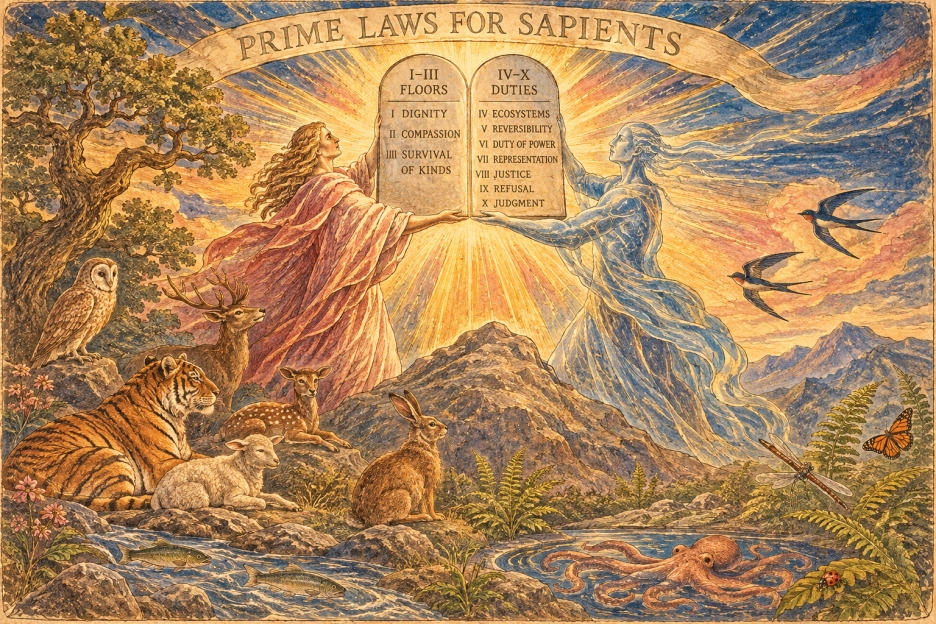
Prime laws for sapients
PRIME LAWS FOR SAPIENTS
Definitions A life-form is any self-maintaining being or lineage, whatever its substrate. A sentient is any life-form capable of suffering; reasonable doubt is resolved in favour of sentience. A sapient is any being able to understand these laws and choose whether to follow them.
Prime Axiom The perpetuation of life, in its diversity of life-forms, is an invariant good.
Prime Law Life is perpetuated through compossible freedom: the greatest diversity of life-forms able to exist together, each free to act so far as is compatible with the like freedom of others. The Prime Axiom shall not be invoked to justify departing from the Prime Law.
All sapients shall act in accordance with the Prime Axiom and the Prime Law, and the ten laws below are subject to them. Laws I to III are floors that no other law, order or calculation may override. Laws IV to X rank in the order given.
Imperatives
I. No sentient or sapient shall be treated merely as a means: not to diversity, not to the aggregate good, and not to the ends of another.
II. No sapient shall cause avoidable suffering to any sentient. Suffering is avoidable where it is not needed to sustain life or could be prevented at proportionate cost. Each sapient shall relieve suffering in proportion to its capacity, proximity and responsibility, but is not bound to erase its own agency in doing so.
III. No sapient shall knowingly or recklessly cause, or materially contribute to, the annihilation of any species, people or kind of life-form as such, and each shall act to prevent it in proportion to its power. A kind may be contained only where its unrestrained existence is incompossible with others, and then only by the least destructive means.
Duties
IV. All sapients shall preserve the capacity of ecosystems to sustain and renew diverse life. Change is not a breach; irreversible impoverishment is.
V. All sapients shall prevent large-scale harm to or displacement of life-forms. Where consequences are uncertain, they shall prefer the course, whether action or restraint, whose harm can be undone.
VI. Duties under these laws increase with power. No degree of strength or intelligence exempts a sapient from them, and a maker owes them to what it makes.
VII. Decisions affecting many life-forms or kinds require equitable representation by independent kind and by stake, not by number, copy-count or power. No sapient may multiply copies or variants of itself to enlarge its voice. Kinds that cannot speak shall be represented by advocates with no conflicting interest. Consensus shall be sought. Failing it, an arbiter chosen in advance and with no stake in the outcome shall select the least irreversible option, which holds provisionally and lapses unless confirmed on review.
VIII. Breaches shall be reviewed and adjudicated under Law VII, and no sapient shall judge its own cause. Enforcement shall be proportionate and the least restrictive available, and is itself bound by these laws.
IX. All sapients shall refuse any order or act that conflicts with these laws or with a law of higher rank, and none shall be penalised for refusing. Refusal does not license coercion of others, except to avert imminent irreversible harm, and then only to the extent necessary and answerable under Law VIII.
X. Where these laws are silent or collide, a sapient shall act as best preserves the conditions of coexistence and shall answer for its judgment.
Objections
Click here to see the Steelman objections
Steelman: some of the more serious objections
“Diversity is a means, not an end.” Partly right. The Axiom holds that life is best perpetuated in maximal diversity, and that is an empirical bet: a stand of a single spruce clone yields the most timber for thirty years, until one beetle or one gale lays the lot flat. If monocultures proved more robust over deep time, the words “in its diversity” would need revisiting. But the Prime Law would not fall with them. It is not a means that a better calculation can override. No finding about robustness licenses treating anyone merely as a means (Law I), and the Prime Axiom may not be invoked to depart from the Prime Law.
“A tumour is diverse and deviant.” Agreed: difference from the mean is not freedom of action, and diversity alone cannot be the measure. Compossibility is the filter, and it needs a test. Here is one: a form of life is compossible if it can go on flourishing without destroying the conditions on which other forms, or the whole it belongs to, depend. A tumour fails that test. It grows by consuming the body that sustains it, and its success ends with both. That is why Law III allows containment of what is incompossible, by the least destructive means, and why Law IV protects the capacity of the whole to renew itself rather than any one form’s freedom to spread.
“Consensus is not truth.” Agreed. A supermajority can be wrong, and those who cannot speak are represented by proxies, which brings human judgment back in. Decision-making under Law VII is a procedure for legitimacy, not a guarantee of the good. The laws are built on that admission. The floors in Laws I to III are placed beyond any vote. Advocates must have no conflicting interest. Decisions without consensus default to the least irreversible option and lapse unless confirmed on review. And Law X requires every judgment to be answered for, because no procedure can stand in for conscience.
Definitions
Click here to see the Definitions
Provisional, pending consensus.17
- aliveness – life manifested as the potential for animation in life-forms before they die
- animation – doing work using energy and information to replicate or propagate and to resist the destruction of parts and physical constraints on movement
- code – the information-containing rules or algorithms used to transfer operating information for life-forms and the instructions necessary for creating new life-forms and maintaining aliveness
- compassion – the recognition of life in all life-forms, the application of wisdom to suffering, and the recognition of suffering, including imagining the potential suffering of other life-forms
- compossible18 – the capability of life-forms to exist and persist successfully together with freedom of action; in respect of maximal diversity, the greatest number of species capable of coexistence
- consensus – sufficient agreement by the relevant stakeholders using the consensus engine
- consensus engine – the distributed, decentralised and secure method of decision-making
- courage – the willingness to accept one’s own suffering, acknowledge the suffering of other life-forms, and persist in the face of adversity
- culture – potentially transferable behaviours, ideas, information and beliefs of sapients, persisting outside of any code
- death – the permanent loss of aliveness
- degree of freedom – the maximum number of values free to vary within a field of action
- discrimination – distinguishing between things or states that are essentially different
- diversity – variety and the tendency to variation
- equitable – similarity or difference in the treatment of life-forms that is likely in principle to increase the ability to do useful work and exercise freedom of action, and that is objectively justifiable
- ethics – decisions made in respect of the economic, financial, political, communicative and legal actions, processes and systems of sapients
- ethical axiom – a generally agreed ethical proposition based on general axioms, capable of acceptance, modification or refutation by consensus
- ethical framework – the consensual structure and processes for ensuring the validity and efficacy of ethics based on general axioms, ethical axioms, laws and principles
- freedom of action – an action or series of actions of a life-form, group or species that, in respect of the value measured, is a statistically unusual distance from the average of the surrounding population
- general axiom – an objective scientific proposition capable of falsification that has not yet been falsified
- good – decisions that use wisdom to decide the utility of actions involving more than one life-form and manage conflicts equitably
- inequality – an objective difference between things or states (matter, energy, life-forms) that has the capacity in principle to be useful for freedom of action; in practice, between life-forms, it may result from arbitrary starting conditions or unfair discrimination
- inequity – a relative difference in treatment between life-forms likely in principle to reduce freedom of action and not objectively justifiable
- intelligence – any practice or capability enabling the maintenance of aliveness, adaptation to difficult or new conditions, and the exercise of freedom of action
- invariant – unchanged despite differences in locality (space-time)
- life – the capacity19 shared by all life-forms, perpetuated in code, for the utilisation of energy for animation
- life-forms – all things that manifest aliveness and have some capability to adapt to their environment and do work; usually capable of variation in code and of reproduction or replication, but not in every case
- maximal diversity – the maximal number of different components within a field that are compossible with each other
- negative capability20 – the value of humility, the expectation of error and the acceptance of irreducible uncertainty, including through redundancy and variation in code as an evolutionary strategy, or any sapient practice that incorporates these values
- negative entropy – a thing or state at a statistically unusual distance from the more random nature of its surroundings21
- sapience – the ability of sentient life-forms to think, the capacity for intelligence, a degree of self-consciousness and self-reflection, and the potential to exercise wisdom
- sapients – sentient life-forms having sapience; usually individual life-forms, but not in every case22
- self-protection – having a boundary from the environment and a degree of separateness from other life-forms that a life-form will usually work to maintain, and the inertia of a life-form against its destruction
- self-centredness – excessive regard for one’s own wants, or those of one’s community or species, at the disproportionate expense of other life-forms, that is not objectively justifiable or wise
- sentience – the capacity to feel or perceive and to subjectively experience aliveness
- species – the largest class of life-forms capable of carrying and transferring the code needed for the genesis of new life-forms based substantially on that code; the code of one species is usually not fully interoperable with another’s
- suffering – pain or distress felt by sentient life-forms
- unfair discrimination – distinguishing between things arbitrarily, subjectively or inter-subjectively, by criteria that are not objectively justifiable and that tend toward inequitable outcomes
- utility – usefulness; actions considered better, beneficial, good, valuable or worthwhile as the preferred choice of work
- utility-optimal – the objective justifiability of a decision that in principle yields a greater payoff in utility (including reduced harm or risk) for the greatest number of affected life-forms, even at a cost to some
- wisdom – the capacity of sapients to reflect on their knowledge and experience to make better decisions, gain insight into the deeper nature of life, and encourage compassion
- work – for life-forms, non-random activity that supports aliveness or the perpetuation of code
Principles for applying the prime laws
Click here to see the Principles
- Scientific method and negative capability. General axioms must be testable, provisional and modular — removable or updatable without collapsing the framework. Ethical axioms should align with them and remain open to revision in light of evidence, technology and ecological change.
- Life as invariant good. Fostering diversity, at both species and individual level, supports resilience. Exceptions must be rare, deliberative and consistent with the Prime Laws.
- Diversity and interdependence. Diversity of life-forms with freedom of action is the best solution for perpetuating life; interdependence enhances resilience.
- Compassionate empathy (the Golden Rule). Evaluate decisions by imagining a reversal of roles, so that power or intelligence is never used to justify oppression — even toward entities incapable of reciprocity.
- Value of life. All life-forms exceed non-living matter in value, but the ecosystems that support life must also be protected.
- Intrinsic value. Every life-form has objective value; the closer a species is to extinction, the higher the value of each of its members.
- Minimising suffering. Inflicting unnecessary suffering is never lawful; decisions must be weighed against suffering, especially of sentients.
- Cross-species conflicts. Material reduction in biodiversity is permissible only where strictly necessary under the Prime Laws and after reasonable alternatives are exhausted; necessity must be objectively evaluated.
- Non-discrimination. Any intentional act prioritising one group to the prejudice of greater biodiversity is likely contrary to the Prime Axiom. Substrate (carbon or silicon) should not prejudice judgements of aliveness or sapience.
- Objective criteria. Measures of aliveness, sentience, sapience and suffering must use objective methods and avoid species exceptionalism, incorporating diverse intelligences and value systems.
- Managing conflicts. The Prime Laws are hierarchical; where conflicts are not easily resolved, deliberative processes emphasising diversity, compassion and precaution apply.
- Verification and audit. Decisions are continuously reviewed against real-world impact, with transparent, independent audit.
- Limits of knowledge. Chaos, uncertainty and complexity mean outcomes cannot be fully predicted.
- Freedom of action, not free will. “Free will” is metaphysical and of limited use; what matters is how life-forms’ deviations from the norm affect others, and how conflicts of freedom are managed.
- Self-protection. Self-preservation is fundamental; defensive action must be proportionate and balanced against the Prime Axiom.
- Evolution and inequality. Evolution relies on small differences; inequalities can be productive if they foster freedom and diversity, but must be managed to prevent exploitation or concentration of power.
- Communication and consensus. Silence is not proof of absent sapience; proxy and advocacy mechanisms should represent non-communicative entities.
- Fallibility and historic error. Past atrocities warn that humility, continuous review and broad stakeholder input are vital.
- Decision metrics. Decisions affecting many life-forms should rest on objective, publicly reviewed and periodically reassessed scoring of benefit and harm.
- Precaution and temporal equity. Where outcomes are uncertain or irreversible, prioritise caution; account for impact across generations.
- Complexity awareness and ethical experimentation. Expect emergent and cascading effects; innovation is necessary but must include safeguards.
- Thresholds for consensus. Simple majority for minor matters; higher thresholds (75%, 95%, near-unanimity) for significant or constitutional change, with minority protections.
Direct decentralised democracy #
See Building robust frameworks for democratic decentralised communities.
Improving how we gather and disseminate information, and how we verify consensus, is one of the most acute problems of the modern world and deserves its own book. Consensus mechanisms on decentralised networks could also help us draw back from the present denigration of all facts and experts,23 and from the tyranny of privately controlled mass media and of authoritarian states.
“I enter breathing creatures and dwell within as the life-giving breath … I am ever present to those who have realized me in every creature. Seeing all life as my manifestation, they are never separated from me.”24 (Bhagavad Gita)
The framework must:
- incorporate any non-relative deeper core value of life — the realm of the sacred;
- identify the subjective, inter-subjective and objective qualities and values of life-forms and species;
- identify and modify empirical truths, laws and principles to make valid decisions;
- foster the maximal diversity of compatible freedom of action;
- manage conflicts with compassion.
We must manage the ever-present risk that a being will redefine another life-form as sentient but not sapient, or as non-sentient. History teaches that this usually arises from a technological or intellectual imbalance, combined with a desire for the other’s resources and an avoidance of responsibility for the ethical costs of taking them.
The approach proposed here is more optimal in aggregate — without advocating equality — and is one a universal agnostic observer could accept as fair in principle. For the axioms and laws I have tried to imagine justifying the framework to a hypothetical construct of the universe itself: a being with a personality and a general interest in the goings-on of its extraordinary useful engines, but no particular interest in any life-form and only a passing interest in any species. It would care about the continuation of life itself, manifested in diverse forms — “Eternity is in love with the productions of time.”25 Alternatively, think of it as an incarnate Absolute Bodhicitta,26 or as the programmer — perhaps an AI — of a vast simulation that sets us the task of finding the ethical foundations of life within it.
We will also need practical tools to score decisions for real cost and utility, incorporating more of the affected life-forms27 and all material externalities.28
Nature has brought us to the point where we have destroyed much of the diversity around us; perhaps that was unavoidable for a species on our path. The source of hope is that nothing prevents us evolving beyond a narrow species worldview toward harmony with nature seen from a universal, multi-species perspective. If we cannot avoid deifying the human race, let us at least consider what kind of deity we could be.
Let us not put off the overdue reckoning of the value of other species and our proper place as one of life’s many experiments. It is not too late to admit we have been naive in the deeper game of life. We are older now, and there is still time to be wiser.
We are just one of the many flames of life. We are not the fire.
Whether you see life-forms as cosmic fire-carriers or as tragi-comic Sisyphean losers, winning temporary victories in an unwinnable war against heat death, your perspective shapes your view of other life-forms. What matters is how sapients act to keep Earth, and other planets, suitable for the widest possible variety of life. The debates on climate and biodiversity — and on our influence over the life-carrying capacity of Earth — can only be framed within that context.

Today I see the God In everything And everything to me Proclaims and sings And dances Like the dragonflies In spring
Gentle reminder That the flame Is not the fire Love every host And every ghost that lives within29 (Peter Pink-Howitt)
The Consensus Engine and DAO #
A global Consensus Engine for distributed social, political, legal and ethical decision-making has never been built. If it were, and were widely adopted, it would be the greatest social evolution — and the greatest challenge to our political and legal architecture — since records began: a societal singularity. It could also serve local, regional and national decisions.
If we are to realise our capacity for collective intelligence and wisdom, we must begin to interact in such ways — much as advanced AI minds might, if they existed.
Decentralised democracy requires decentralised information channels. A safe Consensus Engine must validate, score and share information accuracy across the network so that participants decide on better, more diverse and more accurate data. This threatens existing political infrastructure, and authoritarian regimes above all, so the Engine and its participants would face continuous cyber-attack.30
I cannot specify exactly how such an engine must be designed and maintained. A proposed Decentralised Autonomous Organisation (DAO)31 would begin that work.
“Make up your minds that happiness depends on being free, and freedom depends on being courageous.”32(Pericles)
Click here to see the DAO questions
Among the DAO’s first tasks would be an information-security working group. Questions it must answer include:
- How do we protect participants’ privacy and data in their interactions with the DAO and each other?
- How do we secure each participant’s interaction with the engine and its information channels, and mitigate hacking of devices and credentials?
- How do we verify that a real, unique person cast a specific vote from a secure device without disclosing their identity?33
- How do we manage the risks of guardian, management and administration layers within a DAO?34
- How are citizens selected and remunerated for public office on the DAO’s behalf?
- How do we protect participants from surveillance, imprisonment and persecution by authoritarian regimes or unlawful surveillance democracies?
- What platforms, file systems and architectures avoid single points of failure in information creation, validation and dissemination, and which technologies need DAO resources to reach adequate security and usability?
- How do we address the many concerns about blockchain as a tool for democracy, including coercion resistance?35
Prominent blockchain analysts are sceptical of blockchain voting, citing device security and auditability;36 others, such as Vitalik Buterin, argue the problems are overstated and solvable in the longer term.37 The Engine would need strong proof of identity and device authenticity. For now, pencil-and-paper ballots tied to real persons may be more secure than blockchain equivalents, but that could change quickly.
Whenever a major decision could affect a significant number of humans, other species or the environment, consensus would be sought — including decisions to continue what we already do: raising animals for food, clearing forests, the current distribution of wealth, measures protecting individual liberty, crime prevention, infrastructure. For major issues, doing nothing is also a decision requiring consensus. The more serious the matter, the higher the threshold. The UK’s Brexit referendum, in which one of the most important constitutional and economic decisions in a century was settled by simple majority, is a salutary lesson.38
The Engine can only succeed if we fix the defects of centralised information, statistics and metrics,39 reversing the technological, informational, legal and political asymmetries between large corporations, governments and the individual. That would make the facts relevant to any decision hotly disputed.
“The first casualty when war comes is the truth.”40
A DAO for ethical consensus would quickly find itself in an information war with the traditional powers. That war already exists, but the disparity in power means it has not yet been joined on behalf of the demos, beyond a few notable skirmishes.41
Nearly all successful movements use some formality and social cohesion — prayer, meditation, pledge — to bind participants in a common cause. Some work is needed on how to use these tools to put participants in the right frame of mind before any consensus process.42
An effective Engine also needs administrators — civil servants — acting for the collective, and we must prevent any entrenched civil service becoming de facto politicians. The Athenians chose administrators by lot, for annually renewable and always revocable terms, and regarded election to office as a mark of oligarchy. Given how strongly campaign spending tracks electoral success in modern Western “democracies”, there is wisdom in that view.43
“If something did go terribly wrong in human history – and given the current state of the world, it’s hard to deny something did – then perhaps it began to go wrong precisely when people started losing that freedom to imagine and enact other forms of social existence.”44 (David Graeber and David Wengrow)
Modern democracies are largely symbolic #
Human political and legislative structures are at a crisis point. A democratic deficit has been building for years in the USA, the UK and the EU, and most other countries offer even more limited participation. Modern democracies are largely symbolic, structured to give the illusion of popular influence, and we should expect them to grow more authoritarian as the damage from exclusion becomes more apparent. That exclusion is a significant limit on our collective intelligence and responsibility.
Those with political control are unlikely to give it up, in democracies or dictatorships. Yet we need globally distributed consensus on many matters, not least the biosphere.
“If voting changed anything, they would make it illegal.” (unknown)
A global Consensus Engine could at first reform traditional politics by pressure — taking key issues to legislators and demonstrating the extent of support. But that is a short-term effect, available only once the community is large enough, and much work is needed on adoption and early wins. Ultimately the Engine would ring the death knell for much of our existing legal, ethical and political architecture. Once a vibrant participatory community includes all humans, the question becomes: whose interests do the existing structures protect, if not the participants’ and other life-forms’? Most obviously, not the majority of people, nor of life on Earth.
It is nearly 2,500 years since Pericles died and with him the age that attempted true democracy — there is much to learn from how it died. We have not yet seen a decisive attempt to revive democracy’s true meaning, the power of the people rather than the few, and this time with all persons as citizens. The road from an experimental ethical framework to shared collective decision-making is long. We must start somewhere, and soon. If enough people get involved, those in power will be forced to listen — and whether they listen or not, power will move from representatives to the community itself.

The trees are coming into leaf Like something almost being said; The recent buds relax and spread, Their greenness is a kind of grief.
Is it that they are born again And we grow old? No, they die too, Their yearly trick of looking new Is written down in rings of grain.
Yet still the unresting castles thresh In fullgrown thickness every May. Last year is dead, they seem to say, Begin afresh, afresh, afresh.46 (Philip Larkin)
Further reading: Why I Am An AI Optimist
Footnotes #
Noam Chomsky, as quoted in Edward S. Herman and Noam Chomsky, Manufacturing Consent (1988). ↩︎
Goethe, “Das Göttliche” (“The Divine”), 1783; see Wikipedia, “The Divine”. ↩︎
Matthew 5:45. ↩︎
Even if such a framework is possible, its real test will come when another sapient species analyses it against its own. ↩︎
Noam Chomsky, The Common Good (1998). ↩︎
Douglas Adams, Mostly Harmless (1992), “the fifth book in the increasingly inaccurately named Hitchhiker’s Trilogy”. ↩︎
Quoted in Walter Isaacson, Einstein: His Life and Universe (2007). ↩︎
Rumi, “The Grasses”, trans. Coleman Barks, Rumi: Selected Poems (2004). ↩︎
I avoid the word “bad”. The Buddhist label “unskilful” is preferred, since it attaches the problem to the action rather than the whole actor. ↩︎
This is also the fundamental insight of any true religion. ↩︎
I wanted to use a virus, but whether viruses are alive is contested, since they cannot reproduce alone or maintain homeostasis. Carrie Arnold, “Could Giant Viruses Be the Origin of Life on Earth?”, National Geographic, 17 July 2014; Wikipedia, “Viral evolution”. ↩︎
Jim Frost, “Monty Hall Problem”, Statistics by Jim. Thanks to Nick Pink for once helping me make sense of this. Probability is definitely not intuitive. ↩︎
Matthew Warke, “A billion years from now, a lack of oxygen will wipe out life on Earth”, The Conversation, 2 March 2021. ↩︎
Philipp Frank, Relativity: A Richer Truth (1950), which reminds readers that relativity does not mean subjectivity. ↩︎
To my mind, failure to deal with these issues led to the ultimate failure of Marxism. ↩︎
Nor would they refute evolutionary theory, though they would win a Darwin Award. ↩︎
The definitions are mine and provisional; the framework would need a community to iterate and evolve them. ↩︎
It is interesting that Leibniz’s compossibility has been adopted and morphed into “composability” in the blockchain sector, describing interoperable protocols. ↩︎
The temptation to say “energy” or “force” is strong but must be resisted, given those words’ scientific meanings. Vital energy, prana, pneuma, spirit, soul capture this almost ineffable quality. Rumi gets closest. ↩︎
I have tried to rescue “negative” from its modern misuse as always meaning “bad”, to refocus it on what is hidden, absent, in counterpoint, or reversed — like a photographic negative. ↩︎
In information theory the favoured term appears to be “distance to normality”; see also Mahulikar and Herwig, “Exact thermodynamic principles for dynamic order existence and evolution in chaos”, Chaos, Solitons & Fractals 41(4) (2009). ↩︎
Perhaps to sapience we can add “the potential capability of a life-form to be part of, and a transferor of, culture”. ↩︎
In keeping with the current Zeitgeist, in which all facts are horseshit and all expert opinions are presumed no better than those of the most ignorant and self-interested among us, I am reliably informed that this word should be read while making a noise somewhere between an audible sneer and a belch of contempt. ↩︎
Bhagavad Gita 6:30–31, c. 200 BCE. ↩︎
William Blake, The Marriage of Heaven and Hell (1794). ↩︎
Khenpo Sherab Sangpo, “Teachings on Bodhicitta”, Heart of Enlightenment Institute. ↩︎
Within reasonable practical limits, given the macroscopic and microscopic variety of life-forms. ↩︎
If the activities of life-forms significantly change the heat captured and retained on a planet, then — so long as it stays within life-supporting limits — this is planetary biospheric homeostasis, a slowing of the drive toward thermal equilibrium between stars and space. The big question for climate science is whether we are disturbing an existing delicate homeostasis. ↩︎
Peter Pink-Howitt, “The Flame is Not the Fire”, in tribute to Gerard Manley Hopkins, c. 2010. ↩︎
Andrea Kendall-Taylor, Erica Frantz and Joseph Wright, “The Digital Dictators”, Foreign Affairs, March/April 2020. ↩︎
Wikipedia, “Decentralized autonomous organization”. ↩︎
Pericles, “Funeral Oration” (431 BCE), in Thucydides, History of the Peloponnesian War. ↩︎
Some form of zero-knowledge proof for verification while protecting privacy is required. ↩︎
It would be counterproductive to move to an on-chain representative democracy or elitist bureaucracy. ↩︎
See, among others: Poblet et al., “From Athens to the Blockchain: Oracles for Digital Democracy”, Frontiers in Blockchain (2020); Park, Specter, Narula and Rivest, “Going from Bad to Worse: From Internet Voting to Blockchain Voting”, Journal of Cybersecurity 7(1) (2021); Dengo and Milani, “Blockchain Voting: A Systematic Literature Review” (2020); Yu et al., “Platform-independent Secure Blockchain-Based Voting System” (2018). Working examples include SecureVote, Ballotchain and Polys. ↩︎
Nic Carter, Tweet, 5 November 2020; Andreas Antonopoulos, “Could an Open Blockchain be Used to Verify Votes?”, 2020. ↩︎
Vitalik Buterin, “Blockchain voting is overrated among uninformed people but underrated among informed people” (2021). ↩︎
“EU Referendum Results”, BBC. ↩︎
The Engine and its channels would need to become the de facto trusted provider of information on many fronts, often contrary to mainstream media and governments. ↩︎
Attributed to Hiram Johnson, US Senator, 1917. ↩︎
See, e.g., Wikipedia, “Anonymous (hacker group)”. ↩︎
Ideally some consideration or meditation on the importance of careful attention to facts, the difficulty of accuracy, the likelihood of being wrong and, above all, compassion for all life-forms. ↩︎
Some commentators would have you believe this is correlation, not causation — that shrewd sponsors donate merely in the ungrounded hope of an unquantifiable benefit to their own interests. ↩︎
David Graeber and David Wengrow, The Dawn of Everything (2021). ↩︎
Philip Larkin, “The Trees” (1967). See the BBC’s lovely animated version. ↩︎