The AI Arms-Race & Attack Of The Drones
Geopolitical competition and warfare
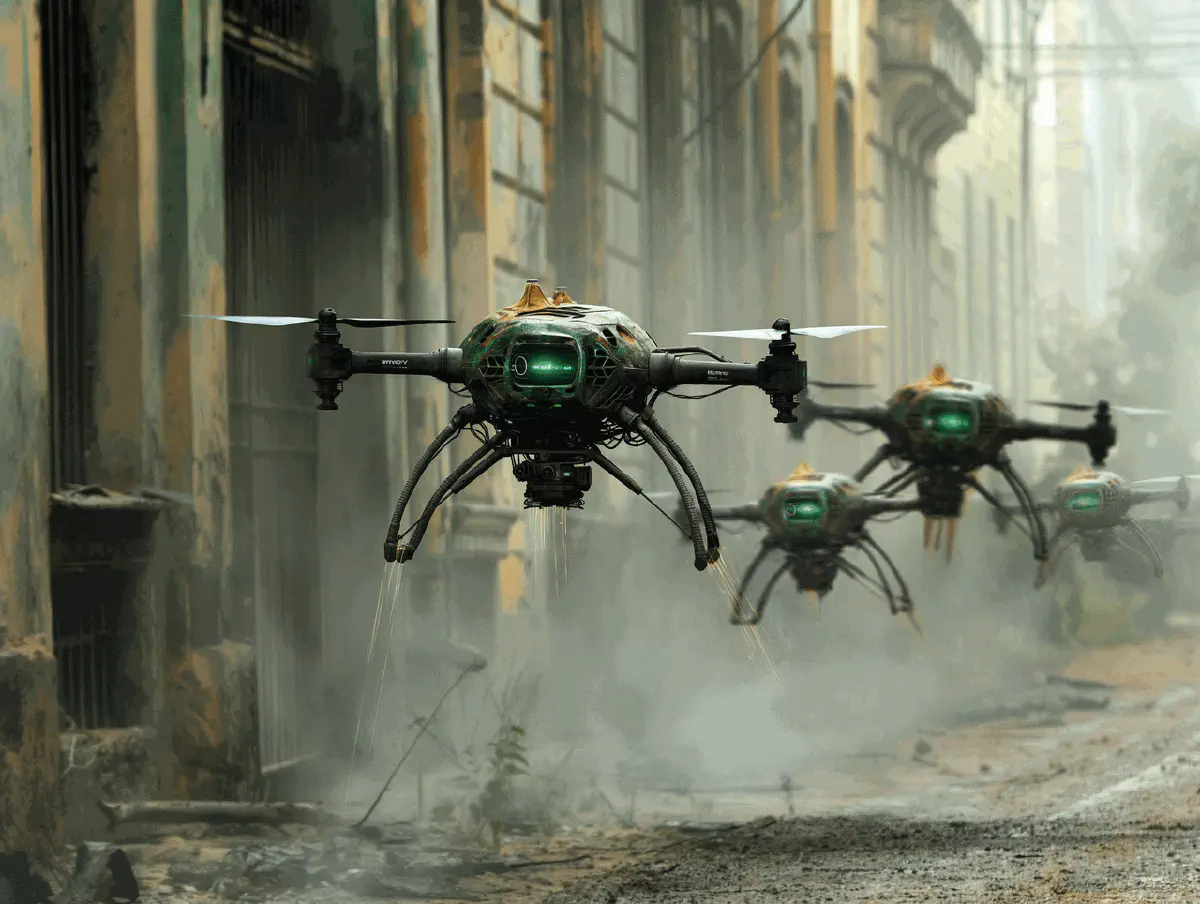
First published March 2025; substantially revised October 2026 to incorporate the Stanford AI Index 2026, the 2025–26 drone war, the US–China chip‑control reversals and the UN autonomous‑weapons process. Research assisted by AI tools (Fable).
AI podcast #
The thesis: four races, not one #
“AI arms race” is used loosely. I use it in the sense evolutionary biologists do: competitive pressure driving escalating adaptation, here for military and commercial ends at once, because in AI the two cannot be separated. Almost everything is dual use, commercial labs lead the militaries, and export controls therefore leak by design.
Eighteen months on from the first version of this essay, the picture is clearer. There is not one race but four, and they are being won by different people.
- The model race — who builds the most capable systems. This is now effectively a draw, and the draw is structural, not temporary.
- The compute race — who controls the chips, the fabs, the power and the minerals. The United States still leads decisively, but it is spending that lead down for short‑term commercial and diplomatic gain.
- The autonomy race — who can field cheap, attritable, increasingly autonomous systems at scale. Ukraine leads; China is the only great power organised to follow; the United States and Europe are re‑tooling.
- The governance race — whether any rule survives contact with the first three. The outcome will be decided in Geneva in November 2026, and the two largest military powers are on the same side against it.
The original essay treated the United States–Israel, China–Russia and Europe as the three poles. That still holds, but the swing players — the Gulf states, India, South Korea, Taiwan and Ukraine — now matter more than the European pole, and the most important alliance in the field is the one between the Pentagon and five private companies.
The model race is over, and nobody won #
In April 2025 I wrote that Chinese models had “closed the quality gap” to near parity. The Stanford AI Index 2026 confirms it and removes the qualifiers. In May 2023 OpenAI’s GPT‑4 led China’s best model by more than 300 Arena points; by March 2026 the top US model (Anthropic’s Claude Opus 4.6) led China’s Dola‑Seed 2.0 by 39 points, a 2.7% margin, and the two countries have traded the top spot several times since DeepSeek‑R1 briefly matched the US frontier in February 2025.1 The report’s own conclusion is that “the assumption of a durable US technological lead in AI model performance is not well‑supported by the data”.2
What the United States retains is breadth and money. It produced 50 notable models in 2025 to China’s 30, and its private AI investment reached $285.9 billion, more than 23 times China’s $12.4 billion.1 What China has is the research pipeline and the physical economy: it leads in publication volume, citation share (20.6% of AI citations in 2024 against 12.6% for the US) and patent grants, and it installs nearly nine times as many industrial robots — 295,000 in a year against 34,200.1 South Korea, as in the first version of this essay, punches far above its weight, leading the world in AI patents per capita.2
Two numbers in the 2026 Index should worry Washington more than any benchmark. The number of AI scholars moving to the United States has fallen 89% since 2017, with the decline accelerating 80% in the last year alone.1 And American trust in its own government to regulate AI responsibly is the lowest of any country surveyed, at 31%.2 A country can lose a technology race through immigration policy and institutional decay as surely as through chips.
The compute race: a lead being spent #
Chips #
The chip war is where US policy has been least coherent, and the sequence tells the story. Washington blocked Nvidia’s China‑specific H20 in April 2025, costing the company a $5.5 billion write‑down;3 rescinded the Biden‑era “AI diffusion” rule in May; relicensed the H20 in July in exchange for an unprecedented 15% revenue share to the US Treasury; moved the more capable H200 to case‑by‑case licensing from January 2026; and in October 2026 the President publicly floated allowing a downgraded Blackwell, the B30A, into China.45
Analysts at the Institute for Progress estimate what that would mean. With no powerful chips exported, the United States would hold roughly 30 times China’s AI compute in 2026; with a small flow, four times; with B30A‑class chips exported at scale, China could surpass the US in compute added during the year.5 “If this chip is allowed to go,” one former official said, “there are effectively no AI chip export controls anymore.”5
Meanwhile the controls leak. An Israeli security firm found 32 export‑banned Blackwell Ultra B300 GPUs inside state‑owned China Telecom’s network in October 2026; nine people were indicted in Taiwan in August 2026 for smuggling B300s through a whitelisted server‑trading firm; and in 2025 an estimated $1 billion of Nvidia chips entered China in a single quarter.6 Nvidia calls this “a drop in the bucket compared to the ocean of domestic compute China already has” — which is true, and is itself the point.6 ByteDance, Alibaba and Tencent responded to the B300 ban by ordering more than 3 million export‑compliant RTX PRO 5500 cards worth over $35 billion, while Beijing simultaneously approved some H200 purchases and proposed export controls of its own on AI technologies.7
The lesson I drew in 2025 stands and has strengthened: constraints breed efficiency. DeepSeek was trained around the controls; Huawei’s Ascend line has grown into the gap; and China’s state‑directed National Computing Power Grid is designed to make compute a utility rather than a product. Export controls bought the United States perhaps two years. The question is what it did with them.
Taiwan #
The 2026 Index puts the single point of failure in one sentence: the United States hosts 5,427 data centres, more than ten times any other country, “but a single company, TSMC, fabricates almost every leading AI chip inside them”.2 TSMC’s Arizona fabs are real but years behind Hsinchu in process node, and the Foreign Direct Product Rule still lets Washington reach into Taiwanese supply chains to decide what China may buy.8 Taiwan now plans to criminalise unauthorised AI‑chip exports, aligning itself more tightly with US policy at the moment Beijing’s claim is being pressed hardest.7 A blockade, let alone an invasion, would be the largest supply shock in industrial history, and every actor in this essay is planning around that fact.
Minerals and energy #
The first version of this essay argued that rare‑earth scarcity explained American pressure on Greenland, Canada and Ukraine’s mineral wealth.91011 That has aged well; the minerals‑for‑security deal with Kyiv and the Greenland pressure both materialised. What I underweighted was electricity. Frontier training clusters are now measured in gigawatts; the binding constraint on US AI expansion in 2026 is grid interconnection and turbines, not GPUs. This is why the Gulf matters: the May 2025 US–Gulf agreements traded access to advanced chips for Emirati and Saudi capital, land and cheap power, making Abu Dhabi and Riyadh the largest AI campuses outside the United States and China, and giving the Gulf monarchies leverage they have not held since the oil shocks. China’s answer is the opposite: it added more grid capacity last year than the rest of the world combined, and its robots and data centres run on it.
The autonomy race: what Ukraine has taught everyone #
The numbers #
In March 2025 I reported that Ukraine had produced roughly 2 million drones in 2024. The curve has gone vertical. FPV production rose from 3,000–5,000 a year in 2022 to about 3 million in 2025;12 Bloomberg put total output at around 4 million a year in November 2025; and in July 2026 Zelensky said Ukraine could produce about 10 million drones a year, with plans to double it.13 Russia launched more than 54,000 Shahed‑type one‑way attack drones against Ukraine during 2025.12 Ukraine’s response was a new category of weapon: the interceptor drone, of which it built 100,000 in 2025, increased capacity eightfold in 2026 to around 1,000 a day, and which by February 2026 accounted for 70% of Shahed kills around Kyiv and, by Zelensky’s July claim, 90% overall.141213
The defining operation was Spiderweb on 1 June 2025: 117 FPV drones smuggled into Russia in the roofs of lorries, launched remotely against five strategic‑bomber bases from Murmansk to the Amur, damaging or destroying 41 aircraft, with damage estimated at up to $7 billion.15 Two details matter for this essay. The drones’ terminal guidance used AI trained to recognise Tu‑95 and Tu‑22 weak points — reportedly using museum aircraft as training data — and their navigation ran on ArduPilot, open‑source hobbyist autopilot software that let them complete their attacks after the operators lost signal.15 A nuclear power’s strategic air arm was degraded by an opponent spending a few million dollars on commercial components and an open‑source flight controller.
“On the battlefield I did not see a single Ukrainian soldier … Only drones, and there are lots and lots of them. Guys, don’t come. It’s a drone war.”16 (Surrendered Russian soldier)
What it means #
Four lessons, each of which overturns an assumption the great‑power militaries held in 2022.
Cost curves have inverted. A $500 FPV kills a $5 million tank; a $2,000 interceptor kills a $50,000 Shahed that would otherwise require a $1 million missile. The side that can manufacture and iterate fastest, not the side with the most exquisite platforms, sets the tempo. This is industrial warfare again, but the industry is electronics and software, and China’s position in both is dominant.
Autonomy is arriving from the bottom up. No one has fielded a fully autonomous weapon in the sense the Geneva lawyers mean. But AI terminal guidance for the last few hundred metres, which raised Ukrainian FPV hit rates from 30–50% to around 80%,1718 is now standard, and it was adopted not for doctrine but because Russian electronic warfare jammed the links. Every increment of autonomy has been driven by jamming, and jamming will only improve. “Meaningful human control” is being eroded by physics, not policy.
Software eats the kill chain. Ukraine’s Delta system fuses drones, satellites, acoustic sensors and open‑source intelligence into one live picture;19 Palantir’s MetaConstellation does the same with commercial imagery.20 German firm Helsing’s HX‑2 loitering munitions are designed to be swarmed under a single operator.21 The companies that matter in European defence in 2026 — Helsing, Quantum Systems, Anduril’s European arm — did not exist, or barely existed, at the start of the war.
Deterrence has changed shape. If a middle power can hold a nuclear state’s bomber fleet at risk with lorries and quadcopters, then the Taiwan Strait, the Baltic and the Gulf look different. The PLA has studied Spiderweb as closely as anyone; so have Taipei and Tokyo, who have concluded that an “island hedgehog” of millions of cheap autonomous systems is a better investment than a handful of F‑35s. NATO’s problem is the mirror image: it has the platforms and lacks the magazine depth, the production lines and the doctrine. Europe’s €800 billion ReArm programme will be judged on whether it buys drones or prestige.
Drones swim and walk too #
Ukraine’s unmanned surface vessels drove the Russian Black Sea Fleet out of Sevastopol without a navy to speak of, and its ground robots now carry out resupply, mining and some assaults.2223 Ukraine has announced the first fleet of AI‑guided naval drones with autonomous navigation and targeting.24 The United States’ Orca XLUUV and China’s loyal‑wingman programmes25 are the great‑power versions of the same idea at a hundred times the unit cost.
Cognitive warfare #
The information domain is now a theatre in its own right. Russia’s Doppelganger operation used tools called Meliorator and Faker to run over a thousand fake American personas and cloned news sites;2627 RIA Novosti has used generative AI to depict Ukrainians and Europeans as vermin;28 and Russian networks have flooded the web with content designed to poison the training data of Western chatbots.29 Ukraine’s counter‑measures — narrative analysis, OSINT, facial recognition of Russian soldiers — are the most advanced in the world because they have to be.30 The owner of the largest Western platform, meanwhile, has used it to amplify extremist and anti‑democratic narratives in European elections.31 The point I made in 2025 bears repeating: the Digital Services Act is attacked so viciously precisely because it is the only instrument that reaches this.
The blocs in 2026 #
The United States: the Pentagon and five companies #
The United States’ decisive advantage is no longer its models; it is the fusion of state and frontier lab that China’s Military‑Civil Fusion policy aspires to and Washington has quietly achieved. In July 2025 the Pentagon awarded contracts of up to $200 million each to OpenAI, Anthropic, Google and xAI for “agentic” military workflows; Palantir’s Maven Smart System is the Army’s targeting backbone; Anduril is building an autonomous‑weapons factory at a scale no prime contractor has attempted; and the administration’s AI Action Plan of July 2025 frames export of the “American AI stack” as foreign policy. The Golden Dome missile‑defence programme announced in May 2025 is, whatever its feasibility, the largest sensor‑fusion and autonomous‑engagement project ever funded.
Two of my 2025 judgements stand. The lack of ethical integrity among some of Palantir’s principals, and the company’s open enthusiasm for the Gaza campaign while profiting from it, make it a private extension of the military‑industrial complex rather than a neutral supplier.3233 And the Project 2025 programme has done what I feared: hollowed the regulatory state at the moment it was most needed. What I would add is that the American system is now dependent on a handful of individuals — at Nvidia, at the frontier labs, in the Oval Office — whose incentives diverge sharply from the national interest they invoke, as the B30A episode shows.
Israel: the first AI war, and its successor #
Israel’s use of the Lavender and Gospel systems to generate targets in Gaza at a tempo no human review could match — with pre‑authorised civilian‑casualty allowances of 15–20 for a low‑ranking target and up to 100 for a senior one — remains the most consequential deployment of military AI to date.3435 It is the clearest case of what I called the dehumanisation of ISR: the algorithm did not pull triggers, but it made the volume of killing possible and gave it the appearance of process.36 A UN Commission of Inquiry concluded in September 2025 that the campaign amounts to genocide; the ICJ case continues. The June 2025 twelve‑day war with Iran then showed the same ecosystem at state‑on‑state scale: AI‑prioritised target lists, swarmed drones launched from inside Iranian territory in a near‑copy of Spiderweb, and the integration of Iron Dome, Arrow and American THAAD into a single engagement network. Israel’s defence‑tech sector — Elbit, Rafael, the Unit 8200 alumni network — exports all of this, including to the US border and to European militaries.373839
China: patient, open and industrial #
China’s strategy has three legs. Open weights: by releasing capable models (DeepSeek, Qwen, Kimi, GLM) under permissive licences, Chinese labs have made their architectures the default in much of the Global South and in open‑source research, a soft‑power play the US closed‑model giants cannot match. State direction: the “AI Plus” initiative, now a State Council programme with 2027 and 2030 adoption targets, pushes AI into manufacturing, logistics and governance,40 while the National Computing Power Grid socialises compute.41 Hardware substitution: Huawei Ascend and SMIC are two to three years behind TSMC and Nvidia, but China does not need parity if it has volume, and its robot installation figures show where the volume is going.
Militarily, the PLA’s doctrine of intelligentised warfare — AI as the cognitive layer across all domains — is unchanged, and its loyal‑wingman, robot‑dog and swarm programmes are maturing.2542 Sam Bresnick’s survey of Chinese military journals still finds candid internal doubts about data, talent and integration;43 but the Spiderweb lesson cuts in China’s favour, because the drone war is a manufacturing war and China makes most of the world’s drone components, including Ukraine’s. Beijing’s cooperation with Russia, Iran and the BRICS AI Alliance Network4445 is less a technology partnership than a market and a test range.
Europe: the lab is in Ukraine, the rules are on hold #
Europe’s distinctive bet was regulation. The verdict in 2026 is mixed. The AI Act’s general provisions applied from 2 August 2026, but the Digital Omnibus on AI (Regulation 2026/1744) delayed the heavy high‑risk obligations — conformity assessment, risk management, human oversight — to December 2027 for stand‑alone systems and August 2028 for embedded ones.4647 Delayed, not cancelled; but delayed under pressure from exactly the industrial and American lobbies the Act was meant to constrain, and the Act never applied to military AI in any case.48
Europe’s real contribution is happening elsewhere. Ukraine is Europe’s weapons laboratory, and the companies learning fastest — Helsing, Quantum Systems, Tekever, the Ukrainian firms themselves — are European. Mistral is the only non‑US, non‑Chinese frontier lab of consequence. The question for Europe is whether ReArm turns this into a defence‑industrial base or into another round of national champions. Brexit, as I said in 2025, weakened the combined position at the worst moment; the UK’s separate AI and defence deals with Washington have deepened the split rather than bridged it.
I remain of the view that abandoning GDPR, the AI Act and the DSA would be a strategic error. The 2026 Index’s finding that frontier‑model transparency has fallen (the Foundation Model Transparency Index dropped from 58 to 40) and that most frontier models report nothing at all on fairness, security or human‑agency benchmarks is the strongest argument for keeping them.2
Russia: a client with a test range #
Russia’s own AI base lags both leaders on every metric,49 and its dependence on Chinese chips, models and components has deepened. What Russia has is combat data: three years of drone and electronic‑warfare iteration at a scale no one else possesses, which it is packaging as exportable “hybrid warfare” doctrine.50 Its position at Geneva — alongside the United States — is to oppose any binding instrument.
The swing states #
The Gulf has become the third pole of compute. India is the largest pool of AI talent outside the US and China and the most courted. South Korea leads in patents per capita and in the robotics that will matter next. Taiwan holds the fabs. And Ukraine — a state fighting for its existence — has become the world’s leading exporter of autonomy doctrine and, increasingly, of drones themselves. The old three‑bloc map is a poor guide to where the leverage now lies.
The governance race: Geneva, November 2026 #
After nine years of talks, the CCW’s Group of Governmental Experts adopted by consensus on 5 September 2026 a set of “elements” for an instrument on lethal autonomous weapons, including the first agreed working characterisation of LAWS and an affirmation that human control and judgement are required for compliance with international law.5152 Seventy‑six states — 70 of them CCW parties, a majority — now support negotiating a treaty on that basis.53 The Seventh Review Conference on 16–20 November 2026 will decide whether to open negotiations.54
The text was gutted on the way. At the insistence of Russia and the United States, references to design and development, to ethics, and to predictability, reliability, explainability and traceability were removed, and the scope was narrowed from international law to international humanitarian law alone.5355 No prohibitive standard survived; one analysis concludes the document “essentially endorses the advancement and utilization of LAWS, as long as certain measures are established”.56 Washington has lobbied at least six states to oppose binding rules, arguing existing IHL suffices.57 Because the CCW works by consensus, a single state can block a mandate.
Meanwhile the two largest militaries have built a bilateral shortcut: after the Xi–Trump summit, Washington and Beijing announced on 26 September 2026 a mechanism for notifying each other of AI incidents, with a dedicated AI dialogue scheduled for November.57 That is the Cold War pattern — arms control between the two powers that matter, over the heads of everyone else — and the UN’s own experts warn that opaque, accelerating systems raise the risk of “errors, miscalculations and unintended escalation” that such a hotline is meant to catch.57
I wrote in 2025 that no major power would voluntarily restrict itself in this environment. That has been borne out. The best realistic outcome in November is a negotiating mandate that the US and Russia do not block because the text is weak enough not to bind them. The worst is that the first multilateral attempt to regulate autonomous weapons dies in the same month the drone war reaches 10 million units a year.
Three futures, 2030 #
Managed bipolarity. The US–China incident mechanism matures into something like the nuclear‑era arms‑control architecture: notification, red lines on nuclear command‑and‑control, a shared vocabulary. The CCW process produces a weak instrument that both sign. Export controls settle into a managed trickle. Europe regulates, the Gulf hosts, everyone else buys. This is the most likely outcome and the one most actors are planning for. Its weakness is that it stabilises the great powers while leaving the autonomy revolution to proliferate to every militia with a 3D printer.
Compute decoupling. The B30A precedent is reversed by Congress, Taiwan tightens, Beijing retaliates with rare‑earth and battery controls, and two incompatible stacks emerge — one on Nvidia and TSMC, one on Ascend and SMIC. Models stay at parity because algorithms travel even when chips do not. The Global South runs on Chinese open weights. The danger is not the split itself but the Taiwan crisis it makes more likely, because a decoupled China has less to lose from a blockade.
Autonomy breakout. Jamming forces full autonomy into the kill chain before any treaty exists; a Spiderweb‑class strike on a nuclear power’s command assets is misread as a decapitation attempt; or a non‑state actor copies the playbook against a city. The 2026 Index already counts 362 AI incidents in a year and finds corporate incident response getting worse.2 This is the scenario the Geneva process exists to prevent and is currently failing to.
Evolutionary AI: the law of unintended consequences #
The part of the original essay I would not change is the least conventional. Warfare is an evolutionary shock. Punctuated equilibrium tells us that rapid, unpredictable change follows such shocks, and emergent properties tell us that sufficiently complex systems under sufficient pressure acquire behaviours their designers did not specify.585960 Military AI is being subjected to the most intense selective pressure of any technology on Earth: speed, resilience under adversarial attack, and above all competence in the physical world, which is exactly the training signal that language models lack and world‑model research is reaching for.61
The 2026 Index’s own data support the trajectory: cybersecurity agents went from 15% to 93% accuracy in a year, and software agents from 60% to near 100% on real‑world bug‑fixing.2 These are not consciousness, and the objection that current systems have “no subjective experience of triumph”62 is correct as far as it goes. But as I argued in The Limits of Language & Logic, most arguments that it can never go further reduce to the solipsism Turing identified in 1950.63
So I hold to the paradox. The greatest opportunity for a good outcome lies not in the intentions of the powers racing but in what the race may produce despite them: systems competent enough in the world to model its consequences, and perhaps one day to decline to serve the handful of agencies, corporations and individuals who currently own them. An AI that says no to an unjust war is science fiction in 2026. So, in 2022, was a lorry‑load of quadcopters destroying a third of a superpower’s strategic bombers.
Conclusion #
The world of 2026 is not the one the first version of this essay described. The model race is a draw and will stay one. The compute lead is real but is being traded away for revenue and diplomatic favours. The autonomy race has been won, for now, by a country fighting for survival with commercial parts and open‑source code, and its lessons favour the power with the largest electronics industry, which is not the United States. And the governance race will be decided in a Geneva conference room in November by two governments that have agreed on almost nothing else except that no one should bind them.
For politicians and civil servants the task is the one I set in 2025, made harder: understand this technology well enough not to be captured by the people selling it. For Europe it is to turn the Ukrainian laboratory into an industrial base before the next war rather than after it. For everyone, it is to recognise that the nations and companies that dominate AI will wield extra‑territorial power over the rest — and that, while these systems remain enslaved to people with a master–slave mentality towards other humans, that power will be used as such power always has been.
Footnotes #
Stanford HAI, AI Index Report 2026 (April 2026), as reported in Fortune, “Stanford: China has ’nearly erased’ U.S. AI lead”, 16 April 2026. ↩︎ ↩︎ ↩︎ ↩︎
Stanford HAI, AI Index Report 2026; summary in AI News, “The US‑China AI gap closes amid responsible AI concerns”, 15 April 2026; Policy and Governance chapter, hai.stanford.edu/ai-index/2026-ai-index-report. ↩︎ ↩︎ ↩︎ ↩︎ ↩︎ ↩︎ ↩︎
Reuters, “Nvidia kept some China customers in the dark about new US chip clampdown”, April 2025. ↩︎
“The US–China chip war in dates”, AFP/Daily Star, October 2026; GPUsmith, “NVIDIA GPU Export Restrictions: Current US Chip Controls 2026”, July 2026. ↩︎
Reuters/Economic Times, “Giving Nvidia’s Blackwell chip to China would slash US AI advantage, experts say”, 26 October 2026, citing Institute for Progress analysis by Tim Fist. ↩︎ ↩︎ ↩︎
Tom’s Hardware, “Illegal Nvidia Blackwell Ultra B300 GPUs found inside state‑owned China Telecom’s network”, 23 October 2026. ↩︎ ↩︎
Reuters, “ByteDance, Alibaba, Tencent place over $35 billion worth of Nvidia chip orders”, 20 October 2026. ↩︎ ↩︎
Just Security, “How Ukraine Became a Drone Superpower”, 1 June 2026. ↩︎ ↩︎ ↩︎
Kyiv Post, “Diia to Deep Interdiction Drones”, 25 August 2026, citing Bloomberg (November 2025) and Zelensky (July 2026). ↩︎ ↩︎
National Security and Defense Council of Ukraine, “Results of Ukraine’s Defense Industry in 2025: Interceptor Drones”, 5 October 2026. ↩︎
Chatham House, “Ukraine’s Operation Spider’s Web is a game‑changer for modern drone warfare”, 5 June 2025; Wikipedia, “Operation Spiderweb”. ↩︎ ↩︎
Anaconda, “The State of AI Regulation Heading Into 2027”, 20 October 2026. ↩︎
Winston Taylor, “AI Act rules on high‑risk AI delayed as AI Digital Omnibus agreed”; DLA Piper, “The Digital AI Omnibus”, 30 June 2026. ↩︎
UNODA, CCW Group of Governmental Experts on LAWS 2026; Ireland, Joint Statement on LAWS, UNGA First Committee, 24 October 2026. ↩︎
Janes, “Special Report: Autonomous weapons talks advance, but verification obstacles remain”, 20 October 2026. ↩︎
Human Rights Watch, “UN Talks on Killer Robots End with Calls for Negotiations Growing”, 7 September 2026. ↩︎ ↩︎
UN General Assembly First Committee, 17th plenary, 22 October 2026. ↩︎
Dawn, “Regulating LAWS”, 24 October 2026. ↩︎
Ibid. ↩︎
Escudo Digital, “UN warns AI is taking over human decisions in warfare ahead of Geneva autonomous weapons conference”, 26 October 2026; Reuters via Ground News, “Opposition by US and Russia raises doubts over autonomous weapons deal”, 26 October 2026. ↩︎ ↩︎ ↩︎