The Rape of Europa: Sovereignty, Security & The Ethical Tech Opportunity
Europe must create strategic, digital and military sovereignty and forge a new identity now or forever remain a US vassal state in chains, fettered and preyed upon.
The Reckoning, Part 3 of 6: The Rape of Europa · Sovereignty, security and the ethical technology opportunity · first published 22 October 2025
Following on from:

Introduction #
Europe is in great danger, it faces a moment of profound vulnerability (Titian’s ‘Rape of Europa’ seemed apt).
“…while he looked forward to hoped for
Pleasures, he slobbered all over her hands,…
Thus swimming out farther, he carried his prey off
Into the midst of the sea. Almost fainting with terror she glanced back,
As she was carried away, at the shore left behind."1
A new geopolitical landscape has emerged, threatening to dismantle the continent’s newly acquired political and economic cohesion and strength - it lies vulnerable and attractive to a sordid collection of aggressive predatory forces (led, in some cases, by men credibly accused of, or found liable for, sexual abuse).2
This post explores and consolidates previous articles outlining the confluence of systemic risks and strategic opportunities that demand immediate, decisive action from the European Union (and the UK!).
The new geopolitical landscape is defined by a convergence of hostile illiberal powers, the rapid weaponisation of dual-use technologies like Artificial Intelligence (AI), and a catastrophic erosion of democratic norms in countries across the globe, including the United States & Israel. This convergence presents a profound and existential challenge to European security, law and economic and political stability.
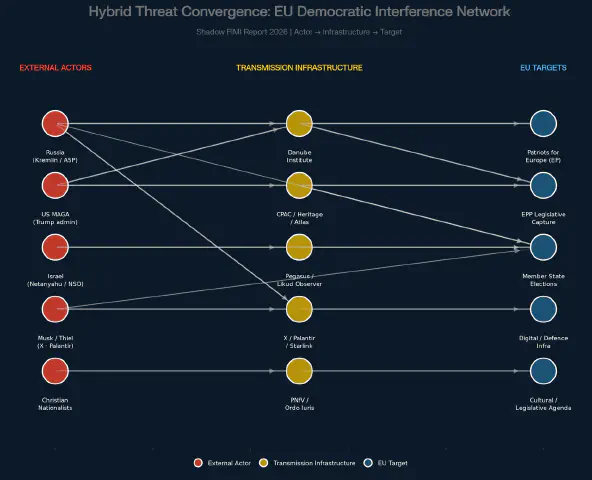
The circumstantial evidence points to an informal “New Axis” involving Putin, Trump and Netanyahu (and the forces supporting them) which collectively functions to undermine the post-WWII international order and position Europe as a strategic target. This external pressure is amplified internally by the rise of far-right movements across Europe, often supported by these same external actors.
Ukraine is currently the primary European victim, but Europe has already been undermined and seriously damaged by those same forces in many complex ways. Russian and American actors among them also supported Brexit and are openly hostile to the EU.
The political path detailed in the Project 2025 blueprint signals a deliberate move to dismantle U.S. democratic checks and balances, leaving core legal agreements like the EU-U.S. Data Privacy Framework without a credible foundation and creating an acute data sovereignty crisis for Europe. U.S. cloud providers, governed by the extraterritorial CLOUD Act, represent a systemic threat to every piece of European data, regardless of its physical location.
This crisis is a wake up call. Europe needs both a strong military autonomy and capability as well as a global ethical leadership role. These are not contradictory drives, indeed one requires the other (as any cursory game theoretic analysis suggests). The stability and rights-based regulatory environment of human rights, the GDPR and the EU AI Act can make Europe a magnet for global tech talent and investment fleeing U.S. volatility. To survive and and not be dominated, Europe must immediately accelerate its pursuit of comprehensive collective sovereignty.
The military industrial base and sovereign dual-use technology crisis in Europe is the most dangerous and damaging. It creates a vassal-lord relationship between Europe and the US which has been used to extraordinary effect to ensure Europe remains weak (and is reliant upon American and Israeli technology, Intel and weaponry). It has fundamentally ensured Europe’s failure to fully support Ukraine as it should in its war with Russia. In addition, there is the terrible human cost of this strategy of facilitation and complicity in respect of the genocide of Palestinians (and the cost to our souls).
This weakness has also ensured that a generation of younger people, and many of the elders too, have lost much of their confidence in the liberal political framework. It has failed to directly and honestly face the issues we are most concerned about: the break down of European cooperation and the failure to realise our combined strength, the rise of authoritarian and far right movements, the environmental crisis and other civilisational level issues impacting Europeans (and the rest of the world).
For too long, liberal politics has increasingly looked like just a friendly face for crony capitalism, naked corruption, increased private control of public goods and of increased wealth & income inequality.
All this is happening whilst the natural world, and it’s beautiful biodiversity, continues to be seriously degraded and damaged in ways that will cause suffering for hundreds of millions (or more) of people and can even be existential for human civilisation. Political polarisation in these conditions is inevitable - “the centre cannot hold”.
It is no coincidence that the march to the far-right in the U.S. has happened during a multi-decade rise in inequality in the U.S. This has enabled even greater capture or co-option of the American political and media landscape (and we have seen the same happening more slowly across Europe).
Apparently, this system of extreme inequality is not good enough for many of the very wealthy (not all are neo-fascist Trump, GOP and MAGA supporters, just most of them it seems), so they want even more and Trump is their leader (or figurehead). The changes made since Trump came back to power are rapidly accelerating poverty and suffering for hundreds of millions of people in America and around the world.
The U.S. was already at levels of inequality that, as I argue in the essay linked below, are comparable to those of a slave society, so it is no surprise we have a supremacist, racist US administration and a largely supportive tech and media industry (and they are transnational forces).
The top 1% of the U.S. holds $54.7 trillion compared to $58.2 trillion for the bottom 90%.
That said, this destabilisation of the post-World War II order also presents a critical strategic opportunity for European states and the EU. For example, for the EU, by offering a stable, predictable, and rights-based regulatory environment it can become an ethical magnet for global tech talent and investment fleeing U.S. volatility (capital and brain drain) – the EU is trying to capitalise on this with projects such as “Choose Europe for Science “. America has previously benefited from the brain drain dynamic, when due to persecution, political instability, and suppression of academic and intellectual freedom thousands of scientists fled the Nazi regime (e.g., Albert Einstein, Enrico Fermi, Erwin Schrödinger).
The EU is positioning itself to be the primary beneficiary of U.S. instability and political extremism giving it the opportunity to be the next global leader in values-driven innovation.To capitalise on this, European states must accelerate the pursuit of comprehensive strategic, digital and industrial sovereignty. This sovereignty can only be achieved by enhanced coordination and a higher degree of centralisation of power in key areas, including in respect of technology investment, development and deployment, our military industrial base, intelligence activities and foreign policy. The great difficulty for Europe, will be to find ways to achieve this ability to coordinate and translate power and foster Europeaness whilst respecting the need for local identities and decision making in areas that do not need to be unified or consolidated. We must also be acutely conscious of the risk of becoming a European version of the American perpetual war machine.
“We are not making a coalition of states, but uniting people”3
We must also remember that man and woman cannot live on bread alone - inequitable and dangerous levels of inequality are not the only driver of the issues we face. We need to forge a stronger European identity that avoids racist and nativist stereotypes. We need something to believe in together. We need to have faith that we can leave this world a better place for the next generations and for all of life’s wondrous forms.
[Note: I have made the various AI Notebooks I use to collate, and query, valuable sources publicly available. See Footnotes below for the various links].
What is European Technology Sovereignty? #
The strategic capacity for the European Union, the UK, Ukraine, Switzerland, Iceland, Norway and other states to coordinate to independently control essential technology infrastructure, data, and our digital future, free from the undue influence, legal extraterritoriality, or political coercion of non-European powers. It is the ability to choose its partners, protect its citizens’ rights (e.g., via GDPR and the EU AI Act), and ensure its defence and economic stability are not beholden to foreign political or corporate whims. This is not isolation, but the necessary foundation for strategic independence in green energy, key dual-use technologies like AI, cloud computing, and defence hardware. It can incorporate alliances with friendly nations around the world including Canada, Australia and New Zealand (as well as Mexico and other countries that face similar pressures and American or Russian rapacity).
Starlink is a security and GDPR threat to Europe: The application of EU law, is profoundly challenged by Starlink’s LEO architecture. It does not publicly disclose where user data is routed, nor does it provide a binding, enforceable commitment that data from EU users will remain within the Union.
– Peter Pink-Howitt (@peterhowitt.bsky.social) 2025-10-30T07:49:04.079Z
The USA is At Very Least An Unreliable Ally! #
The unreliability of the U.S. as a security partner and its involvement in active efforts to destabilise the continent have created an urgent mandate for European strategic autonomy.
Decades of over-reliance on U.S. military hardware, intel and a wide range of technologies have left the EU in a very vulnerable position.
Between the start of Russia’s 2022 invasion and June 2023, nearly 80% of EU member state defence acquisitions were from outside the EU, with the U.S. alone accounting for more than 60%. This dependency is a Trojan Horse making Europe susceptible to even more shakedowns and technological backdoors that render us largely defenceless. In response, work is intensifying on the comprehensive European Defence Industrial Strategy published in 2024 and there are even calls for the creation of integrated European armed forces.
The objective is to build an independent security architecture that is not beholden to the political whims of foreign powers, ensuring that Europe can defend its own interests and territorial integrity and act with dignity in accordance with international law. It would allow European countries to combine and coordinate to project strength and confidence in a multi-polar world, where it should be an equal to China and America and treat them both as they deserve, with our interests taking precedence (in competitive terms), whilst respecting the valid interests and rights of all people in the world.
The Shifting Geopolitical Landscape: An Emerging Illiberal Axis #
I set out the evidence for an informal alignment between the current governments of Russia, the United States and Israel, and the limits of that evidence, in A New Axis Powers?. What it means for Europe is the subject of the first article in this series.
European politicians understandably focus on the more formal alignment between China, Russia, Iran and North Korea, but unfathomably often continue to ignore or are silent on the greater threat from the current leaders of our erstwhile allies. Those European politicians who took Russian money, and the many transatlanticists that dominate German and European politics, have a lot to answer for.
Europe Must Repent, Reform, and Refocus #
Europe has been in a “deep geopolitical sleep,” marked by a hibernatory instinct of extraordinary complacency and over-reliance on the US for security, intelligence and geopolitical positioning. To survive the new reality, Europe must:
- Forge a true European identity based on shared values across countries that include compassion and inclusive diverse identities. It must move beyond the current focus on law and finance to counter rising extreme nationalism.
- Repent, reform, and refocus by admitting our appalling mistakes and complacency, being honest about the people and organisations that are undermining our communities and democracies and by preparing for continued military, economic and political attacks on the European community and project.
- Address internal threats like Hungary’s treachery and the influence of corrupt undisclosed local agents (including business people, politicians and political parties) working unlawfully (or without disclosure) with foreign governments and anti-democratic organisations.
- End European hypocrisy and complicity on fundamental breaches of international laws including human rights, specifically, for example, inaction and complicity for the genocide of the Palestinians.
- Decouple from US geopolitical strategy and militar ydependence & realign its stance in respect of countries like China: acknowledging that the decades-long strategy of “appeasing America at all costs” has been an extraordinary strategic failure (that was obvious even before Trump’s first administration nearly 10 years ago). This will necessarily take time but the pivot must happen.
- Build a sovereign military and dual use technology base.
The current crisis can be the necessary impetus for Europe to wake up, act decisively, and fundamentally restructure its political and economic systems to defend its territorial integrity, culture and citizens.
China knows more than anyone else what happens when you lack geopolitical strategic thinking. In the 19th and early 20th centuries, China was subjected to quasi-colonial domination particularly by Britain, France, Germany, the USA and Japan.
The European Far-Right and External Influence #
The rise of hard-right and far-right parties across Europe is not an isolated domestic phenomenon. It is actively fostered and supported by external actors who seek to undermine the European Union and its democratic values.
I map the nodes, the networks and the money in A New Axis Powers? and here:
Ukraine’s Agony And Europe’s Wake Up Call #
The brutal, unprovoked invasion of Ukraine by Russia is not an abstract geopolitical conflict; it is the visceral manifestation of the ‘Rape of Europa’ metaphor unfolding in real-time. An act of violation and assault on a sovereign nation that directly challenges the foundations of European security, identity, and moral integrity. The lessons for Europe are written in the suffering of our Ukrainian allies.
As of 30 September 2025, the UN had confirmed at least 14,383 civilians killed and 37,541 injured in Ukraine since February 2022, and it has been unable to count the dead in Russian-held territory. Ukrainian agony is Europe’s urgent wake-up call.
The European Military Deficit and the American Stranglehold #
Whilst the EU has finally begun to wake up—with total defence spending hitting an unprecedented €343 billion (1.9% of GDP) in 2024 and forecast to reach €381 billion in 2025 — crucial less obvious dependency mechanisms remain intact:
- The ITAR Veto: The International Traffic in Arms Regulations (ITAR) grants the U.S. a functional veto over the deployment and export of American (some Israeli) and any European equipment containing U.S.-origin components (including, for example, European Saab JAS39 Gripen jets, which fly on an American-derived engine).
- Technological Hostage: The F-35s flown by European air forces are functionally reliant on U.S.-controlled cloud systems (ALIS/ODIN) for continuous software updates and mission data. A U.S. decision to halt these updates would rapidly render the fleet tactically ineffective and vulnerable.
- The Procurement Scandal: The urgency of the Ukraine war exposed this failure, leading European nations to rush procurement from America particularly thereby actively strengthening their industrial base and deepening our dependency and strengthening the bondage. The US supplied 64% of European NATO members’ arms imports in 2020–24, up from 52% in the five years before, and Israel a further 3.9%. Every purchase strengthens their stranglehold on us.
The Intelligence Blindness
C4ISR (Command, Control, Communications, Computers, Intelligence, Surveillance, and Reconnaissance) is where Europe is weakest.
Europe’s critical lack of C4ISR capabilities ensures that any independent military action would be conducted in relative blindness. With only 10 military satellites compared to the U.S. inventory of 185, the intelligence gap of 18.5:1 is one of the many de facto “intelligence vetos " wielded by the U.S.. This weakness was starkly displayed when Elon Musk refused to support Ukrainian requests for satellite internet cover in the Crimea from Starlink during the early stages of the Russian invasion. Musk now controls around 2/3rds of all active satellites.
The intelligence veto means that if European and U.S. interests diverge during a major crisis, European commanders would likely lack the timely, reliable intelligence necessary to justify and execute high-risk operations independently, forcing immediate strategic de-escalation or alignment with Washington’s policy.
This long-standing dependency on the U.S. is not organic or a function of some natural law. The U.S. and leaders of NATO appointed by the U.S. have taken great pains to obstruct attempts to achieve European military autonomy and independence. The U.S. labelled the EU’s Permanent Structured Cooperation (PESCO) and the European Defence Fund (EDF) as “poison pills” for the transatlantic relationship. U.S. opposition also blocked the creation of a permanent EU military command structure and it has issued strong warnings against Franco-German plans, such as the creation of a joint military corps in the early 1990s. We continue to see this mechanism in play at NATO with Europeans, like Mark Rutte, leading the calls for Europe to buy even more U.S. weaponry.
Purchasing U.S. weapons systems (like the F-35, MLRS, and Patriot) deepens European dependency on the U.S. defence industrial base for long-term maintenance, spares, and munitions and provides the American administration with significant bargaining leverage in other policy areas, such as trade, making Europe susceptible to economic pressure. European leaders, aware of the geopolitical risks, have hoped that large-scale purchases of U.S. weapons would ensure continued U.S. commitment and potentially lead to a more favourable trade relationship i.e. we have been buying the Americans off whilst deepening our dependence. It takes a mafia administration like Trumps to take full advantage of this European idiocy.
The risk of European intelligence being leaked to Russia by the U.S. or being misused for human rights and international law offences or relying on misinformation of America and Israel is also now very acute. So much so, that some European agencies are beginning to limit their disclosures. Centralised European intelligence agencies are also needed more than ever.
The collective result of these deficits is a serious geopolitical vulnerability that undermines Europe’s ability to act independently and exposed its security foundation to political volatility. Many European leaders, facing the prospect of being unable to rely on the USA, have finally recognised that only a massive, decade-long commitment focused on achieving genuine strategic autonomy will suffice (see Europe’s Strategic Fightback below). That said there is still an extraordinary amount of complacency and reliance on US-Israeli weaponry. Germany particularly has actually increased its strategic dependency during the genocide in Gaza, and Poland has also been a major purchaser of U.S. weaponry.4
It is estimated that Europe needs an expansion of capabilities equivalent to roughly 300,000 troops and an sustained annual defence spending hike of at least €250 billion to ensure it has military autonomy, but this investment needs to be based on a wide-ranging strategy to fix our pure military and our dual use technology sovereign deficiencies.
The situation in Ukraine also provides European states with an extraordinary opportunity to improve their military capabilities, technologies, training of soldiers and coordinated deployment in a real conflict situation – whilst protecting Ukraine and Europe from further predation.
While European forces cannot fully replace the US security guarantee overnight, a live deployment provides the essential political and operational leverage to drive decoupling initiatives:
- Forcing Investment Decisions: The tangible risk and operational demands would provide the political justification needed to sustain massive coordinated defence spending. The demand for equipment (such as more air defence systems, EW capabilities, and long-range missiles) and the C4ISR blindspots would be immediately realised and quantifiable, accelerating joint procurement and the buildup of a sovereign European defence-industrial base.
- Building Operational Autonomy: Taking on critical roles—like running air defence batteries, providing logistical backfill, or advanced technical maintenance—allows Europe to establish operational autonomy in key domains. This hands-on responsibility, distinct from NATO’s US-led structure, would create the independent habits necessary for Europe to plan and execute complex missions without American authorisation or participation.
- Shifting Political Burden: By placing European “boots on the ground,” European leaders would demonstrate their willingness to share the risk and burden of European security. This directly addresses US calls for greater burden-sharing, but on European terms, strengthening the political argument for an independent coordinated European security pillar. This is not about total isolation but achieving strategic freedom of action.
The only question on these issues are whether our leader’s responses will further enslave us to America or break the chains as quickly as possible. That’s it. Nada mas.
The Climate Crisis: A Multiplying Threat To Sovereignty And Stability #
The escalating climate crisis is not merely an environmental challenge; it is a cataclysmic geopolitical disruptor, a threat multiplier that directly undermines Europe’s economy, internal stability, and external security. Climate inaction and dependence on unreliable partners for green transition technologies represents an extreme risk.
Europe’s commitment to a sovereign, sustainable future—epitomised by initiatives like the European Green Deal —must also be understood as a national security imperative. We are in a fight to protect our community, our citizens and to build strategic independence from a multifaceted crisis and from powers that operate across borders. It is also essential for Europe to coordinate, where possible, with China and any other countries that are showing a willingness to take these climate issues seriously.
The Overlapping Crises of Climate Change, Biodiversity Loss and Political Dishonesty
The Geopolitical AI Arms Race #
AI is rapidly transforming global power dynamics, acting as both a formidable tool for authoritarian control and a potential enabler of democratic resistance. Its development has spurred a geopolitical arms race, with profound implications for warfare, governance, and human rights.The AI arms race primarily involves the United States, China, and Israel, with Russia as another significant but smaller player. AI is being integrated into all domains of warfare.
In addition, authoritarian regimes are systematically using AI to solidify their power and extend their repressive capabilities beyond their borders.
Greater Israel: A ‘Dream’ Of Ethnic Cleansing & The Genocide of Palestinians
AI as a Tool for Democratic Resistance #
Despite its use for social and political repression, AI technology also offers powerful tools for individuals and movements resisting authoritarianism and climate denial. I make that case in:
The Erosion of U.S. Rule of Law and its Transatlantic Implications #
The policy agenda detailed in Project 2025 constitutes an explicit blueprint for dismantling the U.S. system of checks and balances, creating systemic risks that reach across the Atlantic and directly threaten European legal and data governance frameworks. Its implementation is already well underway. I cover the plan and its execution in:
Project 2025 & the Urgent Need for A Defence of American Democracy
The Fight for Digital Sovereignty #
The political shift in the U.S. creates an immediate and severe crisis for European data protection, rendering existing frameworks and commercial solutions inadequate or obsolete
The U.S. political crisis presents a hard legal barrier to any continued reliance on U.S. digital services. The Clarifying Lawful Overseas Use of Data (CLOUD) Act of 2018 explicitly allows U.S. authorities to compel U.S.-based technology companies (like Amazon, Google, and Microsoft) to provide data—including emails and files—upon receipt of a valid warrant, regardless of where that data is physically stored.
The CLOUD Act establishes that the service provider’s nationality/headquarters determines legal obligation, not the data center’s location (e.g., data in a German data centre owned by a U.S. company is still subject to the CLOUD Act).The conflict is simple: the extraterritorial CLOUD Act grants U.S. authorities access to data held by U.S. companies anywhere in Europe, in direct conflict with the EU’s GDPR.
- The Illusion of Sovereignty: Commercial mitigations like “European Sovereign Cloud " solutions offered by U.S. tech titans offer less than they claim. Microsoft’s EU Data Boundary (EUDB), for example, stores primary data in Europe but still transfers system logs and functional data out, where they remain vulnerable to CLOUD Act warrants. U.S. providers cannot legally guarantee protection.
- The DPF’s Fragile Footing: The EU-U.S. Data Privacy Framework (DPF) survived its first challenge when the General Court upheld it in September 2025 (Latombe v Commission), but that judgment is under appeal at the Court of Justice and a ” Schrems III” challenge remains likely. The independence of U.S. oversight bodies is compromised by political interference, making the EU standard of “essentially equivalent” protection unachievable.
The deterioration of the U.S. rule of law necessitates a full recalibration of legal cooperation in other core areas:
- Asylum Status: The U.S. should not be treated as a “Safe Third Country” under EU asylum law due to its attacks on a wide range of groups and given the documented plans to dismantle its own asylum system and violate the principle of non-refoulement (that prohibits a country from sending a person to a country where they would face persecution, torture, or other serious human rights violations).
- Extradition and MLA: Extradition and Mutual Legal Assistance treaties require immediate, intensified scrutiny. The weaponisation of the DOJ (and even the courts) against political opponents makes it imperative to apply the “political offence exception” and rigorously assess whether fair trial guarantees under ECHR Article 6 can be met.
The Only Way Out: Building Sovereign Infrastructure
Europe’s response must be the aggressive development of its own digital ecosystem.
A Strategic Opportunity for Europe: The Ethical Brain Drain and R&I Leadership #
Interlinked with the need for a sovereign military industrial base. We desperately need European headquartered technology titans, including for cloud based applications and services, foundational and applied bespoke AI solutions. Each link in the technology chain must be resilient and resistant to foreign interference and surveillance.
The U.S.’s political and social destabilisation is creating a historic ethical brain drain, offering Europe the chance to become the global leader in talent, innovation, and research - the biggest bastion of ethical tech development in a world of digital authoritarianism and unchecked corporate power.
Ethical Magnet: The EU’s competitive advantage is its commitment to a rights-based framework. In addition to various human rights frameworks, the GDPR and the world-first EU AI Act (which bans unacceptable-risk systems like social scoring) provide a predictable, democratically guided “ethical anchor " for innovation. This stability is actively preferred by top researchers, ethical AI developers, and companies seeking to protect their brand.
Accelerating Innovation: The EU supports this talent through initiatives like the AI Regulatory Sandboxes (EUSAiR), which allow SMEs and startups to test high-risk AI systems in a controlled environment to ensure compliance with the AI Act, lowering compliance costs and easing market entry. This provides a clear, compliant path to market that the U.S. regulatory vacuum cannot match.
Talent Inflow: The EU is already attracting a more international AI workforce, with 37% of its AI talent coming from abroad. Canada’s program to attract H-1B visa holders from the U.S. (hitting its 10,000-applicant cap in two days) demonstrates the urgent global demand for alternatives to the U.S. Europe must capitalise on U.S. instability whilst offering a safe refuge for many of the people that will choose, or be forced, to flee the U.S.
Europe’s Strategic Fightback #
To fully capitalise on the strategic opportunity presented by U.S. instability, the EU is mobilising its industrial and financial policies to overcome historical fragmentation. Ursula von der Leyen has been doing a great job of helping Europe wake up to the challenges it faces (much as I may not agree with her views and stances on many issues, not least the genocide in Gaza), she is a strong leader with deep belief in the EU project and a natural fighter.
Military response #
The foundation is an €800 Billion military mobilisation, as part of the ReArm Europe plan, to significantly boost defence funding and readiness by 2030. Within this, Germany is expected to make up as much as 50% of the total spending. However, how this funding is deployed is crucial if we are to avoid further dependencies on unreliable unhinged allies. The instruments now exist on paper: the Defence Readiness Roadmap 2030, the White Paper on European Defence – Readiness 2030 and the European Defence Industrial Strategy (EDIS). Four things matter most.
Integrating Ukraine’s Industry: Europe is pursuing the integration of Ukraine’s defence industry into the EDTIB, viewing Ukraine’s unique experience and production capacity (especially in drones and ammunition) as a way to augment European resilience and supply chains.
Military Coordination: Europe needs to rapidly enhance military coordination across its fragmented national armies to make up for the cohesive command structure provided by U.S. troops. Proposals include creating a Permanent Standing Pan-European Reaction Force (e.g., 100,000 troops) sourced from non-frontline states to simplify European combat capability.
Intelligence: Efforts are accelerating to build independent intelligence capabilities and strengthen EU intelligence structures, potentially towards a fully-fledged EU service for intelligence cooperation, aiming to bury decades of distrust and counter Russian aggression, a move accelerated by U.S. uncertainty.
Command Structure: The long-term goal includes establishing a European Defence Command independent of NATO structures, potentially by strengthening the EU’s existing military structures, such as the Military Planning and Conduct Capability (MPCC) and the EU Military Staff (EUMS).
Dual use technology response #
Despite previous investments, the EU’s share of global venture capital raised currently stands at only 5%, compared to 52% in the U.S. and 40% in China. This highlights the need to transition research into commercial scale. The Letta and Draghi Reports stress the urgency of addressing Europe’s economic fragmentation and lagging R&D commercialisation. The instruments here are the AI Continent Action Plan, GAIA-X, and the proposed Cloud and AI Development Act and Quantum Act.
This next decade determines Europe’s destiny for many generations.
To deal with the satellite sovereign risks, Europe is developing the IRIS² system. IRIS² stands for Infrastructure for Resilience, Interconnectivity and Security by Satellite. A planned multi-orbit satellite constellation designed to provide secure and resilient high-speed communication services for government users, as well as broadband for citizens and businesses across Europe and in areas of strategic interest globally. It is expected to be fully operational by 2030.
The longer term plans for technological autonomy can also be found within the proposed €2 Trillion Budget for 2028-2034, known as the new Multi-annual Financial Framework (MFF). This framework is the longer term financial “follow-through” for the EU’s response to geo-economic and political shifts and involves investing vast resources in critical areas, including a €410 billion Competitiveness Fund and a €131 billion defence and space budget.
Leaders Must Lead #
If our leaders are not fit for meeting these challenges, indeed if they will not even admit to them (as those of us in the UK are acutely aware), then they are not leaders but willing or unwitting instruments of the adversaries we must overcome.
We must resist, refocus and regenerate our belief in the power of diversity, cooperation and creativity, whilst being wise to the ever present predatory risks we face from our adversaries. We need to strengthen the core of Europe based on hard-won experience of the dangers of unchecked racism, militarism and fascism whilst supporting flourishing local communities and identities.
Europe faces an exquisitely difficult balancing act, but the memory of the dead that precede us (the 100 million dead from two disastrous world wars, the millions of enslaved black people that faced unfathomable suffering from European colonial subjugation and of the murder of millions of Jewish people) demand that we must continue and resolve to succeed in our attempt of the very difficult.
We must strengthen our community based on ethnic and national diversity and of ensuring peace through realism. In achieving this, Europe can help humans move towards a world government that ensures rights, responsibilities and freedoms are not dictated by the lottery of birth and the value of life is not solely based on membership of one species. A system of government that sees all humans as family and as just one common part of the extraordinary diversity of all life-forms on Earth. Ultimately, that’s the only future that is worth fighting for.
‘No man is an island. Entire of itself;
Every man is a piece of the continent,
A part of the main.
If a clod be washed away by the sea,
Europe is the less…"5
Footnotes #
- ‘The Rape of Europa’, Ovid ↩
- See The Epstein Network: Sexual Abuse, State Power, and Impunity, which sets out what is proven, what is alleged and what is denied. ↩
- Speech by Jean Monnet – Washington, 30 April 1952. ↩
- SIPRI, Trends in International Arms Transfers, 2024 (March 2025): the USA supplied 64% of arms imports by European NATO states in 2020–24, up from 52% in 2015–19, and Poland was among Europe’s largest importers. Germany’s orders include F-35s, Chinook helicopters and Patriot systems. This paragraph was first compiled with AI research tools. ↩
- John Donne, ’ No Man Is an Island ↩
Please see the various articles in the public AI Notebooks below for reference material and to query the databases yourself:
- European Defence
- American Authoritarian Risks to Europe & the US Brain Drain
- Autocracy, Democratic Backsliding & Right Wing Extremism: Europe
- Big Tech and the US Digital-Military-Industrial Complex
- AI: Ethics, Governance, Law & Society
- Inequality & Inequity
- Project 2025: A Resource for the People
- Climate Change, Ecological Disaster and Civilisational Risks
- Europe: Sovereignty, Security, and Ethical Technology