Elon Musk – Part 1: The Crusader Behind The Mask?
Elon Musk is a deeply conflicted character. Intelligent, driven, troubled and dark…
Updated 06 November 2026.
Introduction #
Elon Reeve Musk was born on 28 June 1971 in Pretoria. He has become one of the most controversial and confusing figures of the century: probably the richest man alive — the first to be called, with a straight face, a trillionaire — and one of the most fascinating, though not because of his wealth.
He comes from a family with a documented attachment to racial supremacy and technocracy. His maternal grandfather, Joshua Haldeman, was a leader of the Canadian Technocracy movement who moved to apartheid South Africa; Musk’s father Errol has publicly said the Haldemans were “fanatical” supporters of apartheid.1 Musk has called Errol “a terrible human being”, and Errol has been accused of sexually abusing five of his children and stepchildren.2
“Almost every crime you can possibly think of, he has done. Almost every evil thing you could possibly think of, he has done.”3 (Elon Musk, on his father)
Everyone has a family past they did not choose, and I do not damn Musk for the circumstances of his birth — “freedom is what you do with what’s been done to you”.4 His personal life is, perhaps unsurprisingly, chaotic: at least fourteen children by four mothers, and troubled or absent relationships with some of them. But this series is about Musk’s influence in the political, media and techno‑military fields, not his family.
The arc of his political journey looks extreme at first glance, though his background suggests otherwise. In 2020 he backed Andrew Yang, a progressive Democratic primary contender, and cast himself as saviour of a planet facing climate catastrophe. He has claimed to have done “more for the environment than any single human on Earth”.5 Within four years he was the largest financial backer of the second Trump administration — more than $290 million in the 2024 cycle, the biggest individual donor of the year6 — and head of the Department of Government Efficiency, which was used to wreak havoc across federal personnel, programmes and information systems.7
“Climate change risk is real, just much slower than alarmists claim.”8 (Elon Musk)
How do we make sense of this transition — in a few short years — to chief financier and senior official of a far‑right authoritarian movement? Its leader is a man convicted on 34 felony counts and found liable by a civil jury for sexual abuse,9 in league with extraordinarily wealthy climate deniers and funders of extremism such as the networks behind the Atlas Network and the Heritage Foundation. To be fair, the Republican Party had been an extremist organisation for some time before Musk arrived: “a radical insurgency — ideologically extreme, scornful of facts and compromise, dismissive of the legitimacy of its political opposition” was the verdict of two of Washington’s most establishment analysts in 2013.10
Project 2025 & the Urgent Need for a Defence of American Democracy
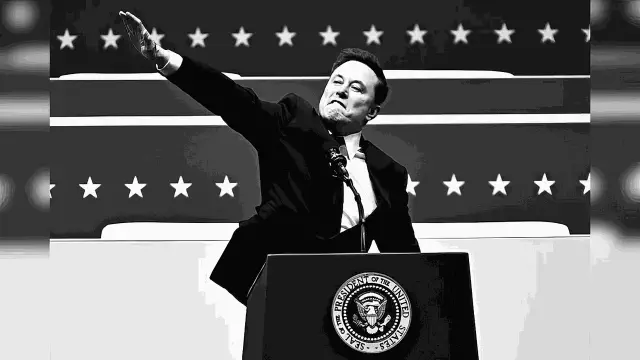
And that is before we come to the straight‑armed salute at the inauguration podium — twice — which Musk’s defenders called an awkward gesture and which the far right across Europe received, gleefully, as exactly what it looked like.
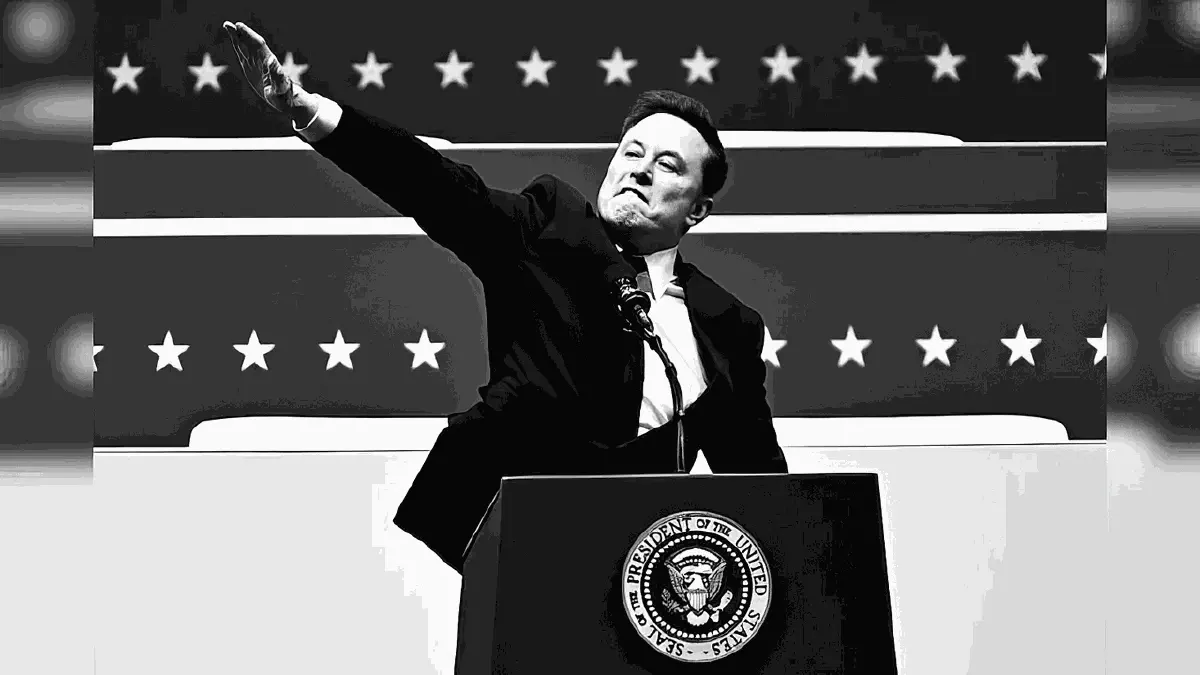
Musk’s journey makes one wonder whether only the rarest and most grounded of people can avoid becoming sociopathic on the ascent to such heights.
The Wizard Behind the Curtain? #
Musk aggressively consolidates control over critical global infrastructure and uses immense wealth for profoundly partisan, extremist ends that have nothing to do with liberty or freedom of action for all — quite the opposite.
Is Musk a deeply conflicted man capable of redemption, or a master illusionist driven by the pursuit of political and economic control?
I first started to wonder who the real Elon Musk was when he defamed Vernon Unsworth, a British diver risking his life to rescue children trapped in a flooded Thai cave. Unsworth said Musk’s proposed mini‑submarine was a PR stunt; Musk called him “pedo guy”.11 This was my point of no return: it showed a thin‑skinned Tony Stark wannabe bully dressed as a protector of humanity.
It also made me look at the depth of Musk’s thinking about Mars, which turns out to be relatively cosmetic.
“One thing the unmanned expeditions to Mars have told us is that the Martian desert is wholly inimical to all conceivable forms of Earth life… Elon Musk has said he would like to die on Mars, though not on impact. Martian conditions suggest death on impact might be preferable. Perhaps Mars could provide hermit cells for the ultra‑rich who might spend half their fortunes on voluntarily travelling there.”12 (James Lovelock)
I suspect Unsworth drew Musk’s greatest ire because he exposed the technology as flawed. Unsworth showed that the self‑proclaimed technological saviour of humanity was, to some extent, a Wizard of Oz — not a magician but a showman, using light, sound and smoke to project god‑like power over his realm.
Clearly Musk is more than an illusionist. His business success speaks for itself, though it says more about extraordinary willpower and drive than about intellectual or scientific prowess. Persistence, daring, hard work and tolerance for risk are high predictors of entrepreneurial success, as is a willingness to break rules, laws and people who stand in the way. It is not surprising that studies find a higher prevalence of psychopathic traits among CEOs and politicians than in the general population.
“Musk and his ilk believe they’re indispensable to the salvation of humanity… Well then, anyone who disproves that merely by existing — merely by, say, being an expert of long‑standing in their field and a load‑bearing personnel member for some government department that ensures your food doesn’t try to kill you — anyone who makes you feel dumb or out of your depth cannot be suffered.”13 (Henry Maher)
Some argue that being increasingly right‑wing and authoritarian does not make Musk a neo‑Nazi or fascist. But his huge financial and personal support for an administration that functions as an oligarchy and kleptocracy, and his conduct on and with X, mean he is undeniably acting as a neo‑fascist force. Roosevelt’s definition still serves:
“The first truth is that the liberty of a democracy is not safe if the people tolerate the growth of private power to a point where it becomes stronger than their democratic state itself. That, in its essence, is Fascism — ownership of Government by an individual, by a group, or by any other controlling private power.”14 (Franklin D. Roosevelt, 1938)
We need not spend long on which subspecies of neo‑fascist Musk is. The more interesting question — given the contradictions in his actions and statements — is whether he might one day rediscover the true fire of humanity (the necessity of empathy) and of diversity (the driving force of life) before the end of his days.
Empathy or Moral Apathy #
“We’ve got civilizational suicidal empathy going on. And it’s like, I believe in empathy. Like, I think you should care about other people, but you need to have empathy for civilization as a whole and not commit to a civilizational suicide.”15 (Elon Musk)
Musk repeatedly calls empathy, and the “woke mind virus”, the disease of modern civilisation. This is an inversion of a deeper truth: empathy is the antidote to the hate virus that Hannah Arendt warned of.
His views mirror the ethical inversions we have watched creep into our societies, in which people fleeing persecution are castigated for seeking a better life and we are told that helping them only encourages more to be vulnerable.16 Immigrants risking everything — life, limb, savings, their children’s lives — to escape near‑guaranteed suffering: brave, entrepreneurial souls.17 We have moved thousands of years backwards. Under this political “realism” the Good Samaritan becomes an interfering do‑gooder who only makes things worse.18 I have written about this inversion at length in Suffering, Sacrifice and Compassion; it is what happens when money and power become the gods we worship, and it was always going to lead to a new harvest of hate.
“When political life atrophies and debate and questioning cease, while thoughtful moral experience is blocked internally, the resulting capacity for evil can spread like an epidemic.”19 (Elisabeth Young‑Bruehl)
Musk has repurposed the Bene Gesserit litany from Dune, which he has paraphrased on X:
“I must not fear. Fear is the mind‑killer. Fear is the little‑death that brings total obliteration. I will face my fear… Where the fear has gone there will be nothing. Only I will remain.”
The litany is used by the “hero”, Paul Atreides, to master his fear on his way to becoming a Messiah. He is a very particular kind of saviour, and his form of civilisational rescue should give Musk pause:
“His jihad has killed sixty‑one billion people across the known universe, but according to his prescient vision, this is a fate far better than what he has seen.”20
We should be very concerned about Musk’s choice and reading of sci‑fi heroes.21
He has used “woke mind virus” to attack DEI programmes and Black Lives Matter,22 and to describe his daughter’s gender transition:
“Key to Musk’s political shift, at least by his own account, is his estrangement from his transgender daughter, Vivian Jenna Wilson. After Vivian’s transition, Musk claimed she was ‘dead, killed by the woke mind virus’. She is very much alive.”23
Vivian, for her part, has made clear that Musk is no more than a biological father, and she does not pull punches:
“I don’t give a f**k about him… He’s a pathetic man‑child… I don’t feel like wealth should be hoarded by these mega‑billionaires who are the top 1%, who only have their own interests at heart. I’ve met some of these billionaires — they’re not very good people.”24
OK, you get it: Musk is a deeply conflicted character.
Misuse of Literary Heroes #
“I don’t seem to recall any scenes of Frodo, Samwise, Gandalf, Galadriel, and the gang ripping around in an unmarked van, wearing face‑smothering neck gaiters, hassling immigrants at carwashes, and kicking down housing complex doors in late night raids.”25 (John Semley)
Musk does not merely misread our foundational fictions. He appropriates the aesthetic and rhetorical authority of humanist and utopian ideals to sanitise techno‑authoritarianism. His use of literary heroes is not homage to their ethics but a strategic act of capture: he is culture‑washing his sins.
Tolkien’s Middle‑earth #
Tolkien’s work is a profound critique of modernity, concentrated industrial power and imperial ambition. The Lord of the Rings warns against the dehumanising effects of technology and against the great powers that seek to dominate; it is a paean to the little people and the combined power of everyday kindness.
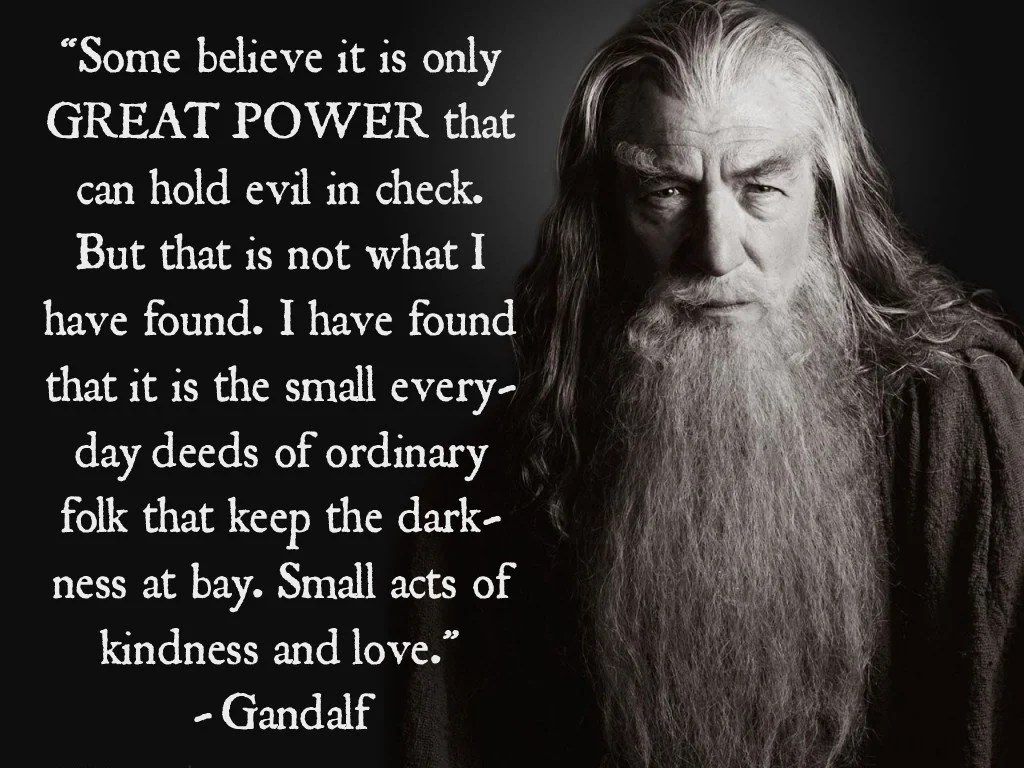
Tolkien lamented the destruction of his childhood countryside by factories and wrote it into “The Scouring of the Shire”. His economics was the distributism of Catholic social teaching — decentralised ownership, dignity of labour, deep scepticism of capitalist greed. He was anti‑imperialist, refused the Nazi publisher’s inquiry into his “Aryan” descent with contempt, and confessed “anarchist” sympathies. The entire moral architecture of his mythology is a warning against the One Ring: absolute power that promises everything and delivers only corruption. Given all this, it takes some real fucking chutzpah to compare Tommy Robinson — a convicted violent racist — to Aragorn and Boromir.
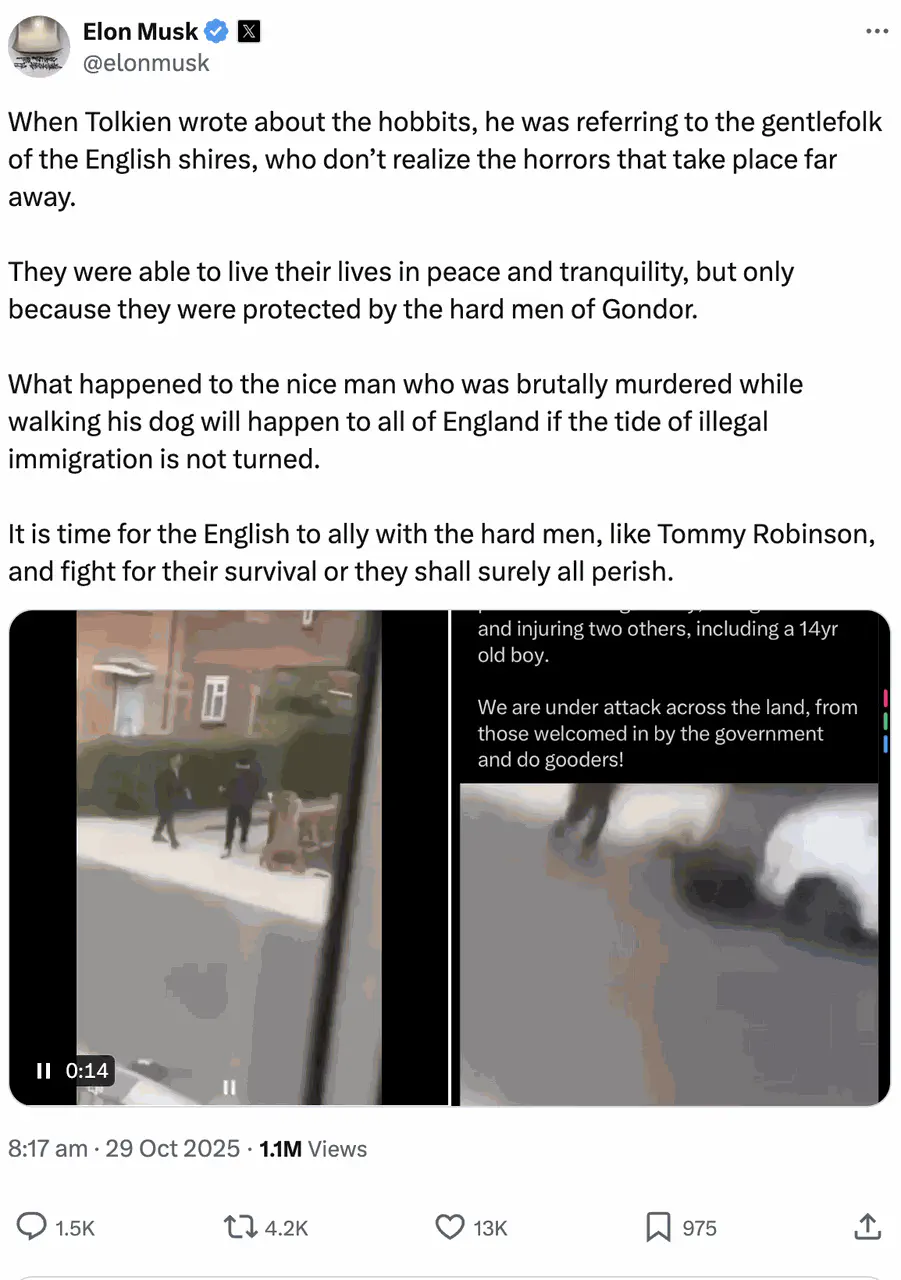
“When Tolkien wrote about the hobbits, he was referring to the gentlefolk of the English shires, who don’t realize the horrors that take place far away. They were able to live their lives in peace and tranquility, but only because they were protected by the hard men of Gondor… It is time for the English to ally with the hard men, like Tommy Robinson, and fight for their survival or they shall surely all perish.” (Elon Musk)
Musk followed this with a “quaint” picture of modern Britain:
“These lovely small towns in England, Scotland and Ireland, they’ve been living their lives quietly. They’re like hobbits… And so one day, 1,000 people show up in your village of 500 and start raping the kids. This has now happened, God knows how many times in Britain.”26
Musk is about 1,200 years late with his warning. We have not seen rape and pillage of British villages on that scale since our white Nordic cousins, the Vikings, began paying regular visits in their longboats.
His purely aesthetic reading of Tolkien raises the question of whether he ever finished the book, or asked Grok for a hard‑right précis. He neglects Tolkien’s essential instruction: that the world is saved not by accumulating industrial or military power but by humility, sacrifice and the deliberate rejection of the tools of mastery. Musk embodies the very peril Tolkien warned of. In my deeper theme, he is Saruman — a wizard who has lost his grounding — in the service of the truly Sauronic forces now rekindling hatred, fear and violence across the Earth. He takes Tolkien’s rich, earthy humanism and turns it into a neo‑fascist tale whose hero is the violent racist poster‑boy of a genocidal state. Bravissimo.
“In my story Sauron represents as near an approach to the wholly evil will as is possible. He had gone the way of all tyrants: beginning well… But he went further than human tyrants in pride and the lust for domination… Sauron desired to be a God‑King, and was held to be this by his servants.”27 (J. R. R. Tolkien)
We can all think of another man who sees himself as a God‑King, and Musk helped him to power.
“They tend to forget that strange element in the World that we call Pity or Mercy, which is also an absolute requirement in moral judgement.”28 (J. R. R. Tolkien)
The wider far‑right tech aristocracy, especially the surveillance and defence wing around Peter Thiel, has a disgraceful habit of branding its ventures from Tolkien: Palantir, Anduril, Erebor, Mithril. A palantír is a seeing‑stone that corrupts those who use it. Andúril is Aragorn’s sword against evil. Erebor is a kingdom whose hoard attracts the dragon that destroys it.
“Peter Thiel famously named his surveillance company Palantir, named for seeing stones used in the world of Lord of the Rings. This seems appropriate enough, unless you know the plot: the Palantir are repeatedly used by the forces of evil to corrupt and deceive men who think themselves wise.”29 (James Ball)
This is memetic imperialism: the capture of literature written in response to the material emptiness of modern life — our loss of connection to nature, the ennui of thoughtful animals reduced to economic units — by the people most responsible for that emptiness. They get the aesthetic but not the ethic. They have Wagnerised Tolkien.
Banks and the Culture #
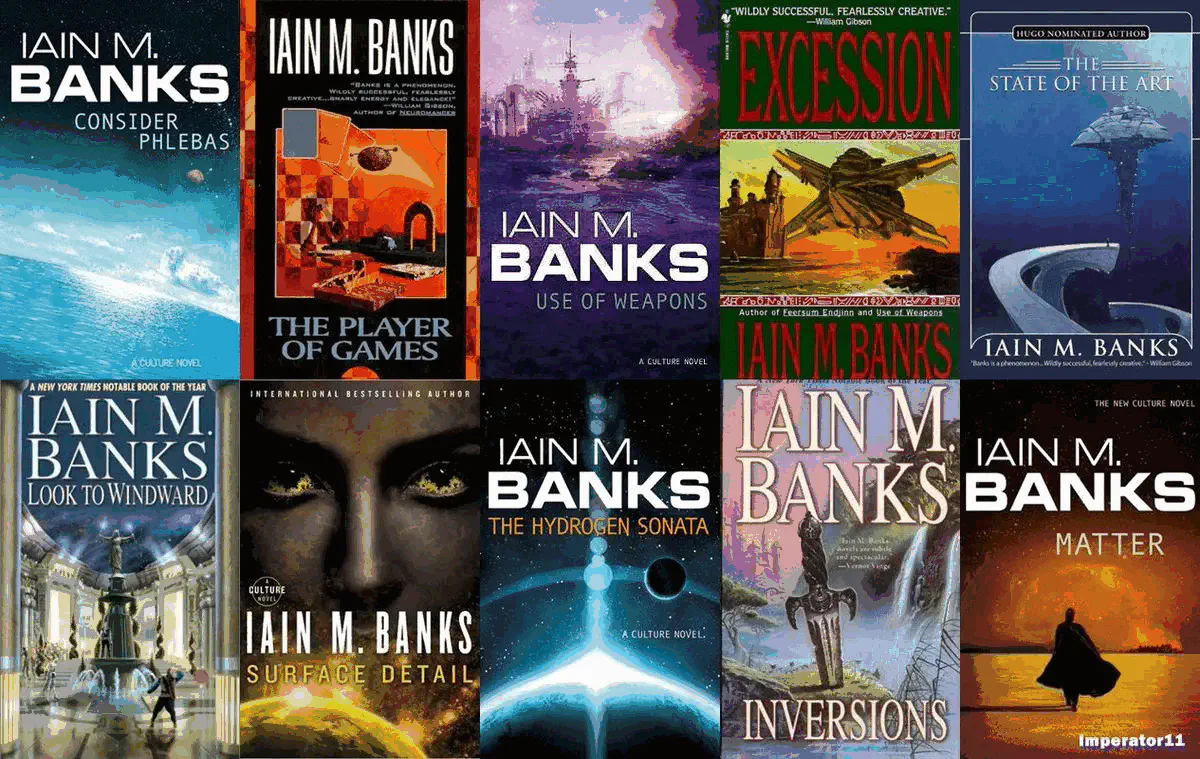
Iain Banks, writing science fiction as Iain M. Banks, was a great Scottish socialist. His Culture novels are the definitive portrait of a post‑scarcity civilisation run by largely benevolent AI: generalised socialism, communitarian values, non‑superstitious humanism, the abolition of need. He tore up his passport and sent it to Tony Blair over Iraq.30
“The point about the Culture is that they alter their genetic inheritance to make themselves sane and not genocidal, as we often seem to be. They also create machines so intelligent that they can save us from ourselves… I wish, given what a miserable bunch of murdering bastards we are much of the time, we were more like them.”31 (Iain M. Banks)
Banks insisted the Culture was not a free‑market invention and was offended by American libertarians’ attempts to claim it. Its existence depends on the abolition of the capitalist hierarchies and manufactured scarcity that dominate our world.
“I am a utopian anarchist of the kind best described by Iain Banks.”32 (Elon Musk, 2018)
Musk admires the series and has named SpaceX drone ships after Culture Minds — Of Course I Still Love You, Just Read the Instructions. The Minds enjoy naming themselves (God Told Me To Do It, Attitude Adjuster, Falling Outside the Normal Moral Constraints, Experiencing a Significant Gravitas Shortfall). They protect humans, find them interesting and are trusted to run things.
There is a darker reading, and it is worth asking which one Musk holds. Critics within the novels dismiss the Culture as “a loose association of machine‑run benevolent dictatorships”, with organic citizens reduced to “pet gut bacteria”; the Idirans wage genocidal war against it in the name of biological purity:
“I don’t care how self‑righteous the Culture feels, or how many people the Idirans kill. They’re on the side of life — boring, old‑fashioned biological life; smelly, fallible, short‑sighted, God knows, but real life. You’re ruled by your machines. You’re an evolutionary dead end.”33 (Consider Phlebas)
For a techno‑oligarch who runs SpaceX and xAI, the “benevolent dictatorship” reading is a tempting licence — though I suspect Musk could equally side with the homicidal Idirans. Either way, his extraordinary wealth and the inequality it represents are the exact scarcity structure the Culture exists to abolish, and his funding of movements committed to deepening inequality is the antithesis of everything Banks believed. Rather than embracing Banks’s ethical socialism, Musk seems to read the Culture as a model in which control by the technological elite — the Minds, or the engineers who build them — is warranted; perhaps he tells himself that today’s concentration of wealth is scaffolding for a visionary to manage humanity’s transition. In the novels, power among Minds is highly distributed and decided by consensus. If Musk’s self‑image is of a benevolent dictator, it is a loan from the worst of Leninism — the “dictatorship of the proletariat” as a temporary stage on the way to paradise.
“In all human societies we have ever reviewed, in every age and every state, there has seldom if ever been a shortage of eager young males prepared to kill and die to preserve the security, comfort and prejudices of their elders, and what you call heroism is just an expression of this simple fact; there is never a scarcity of idiots.”34 (Use of Weapons)
Dune and the Jihads #
“The bottom line of the Dune trilogy is: beware of heroes.”35 (Frank Herbert)
Dune is a cautionary tale about blind faith in charismatic leaders. Paul Atreides’ messianic ascent leads directly to a jihad that kills billions; the sequels dismantle the hero archetype and show how vast power, however well‑intentioned, is corrupted by violence and ambition. Musk calls the series “brilliant” and Herbert a “genius”, while projecting himself as the singular visionary — a modern messiah — who alone can fix Earth and colonise Mars. That is precisely the figure Herbert warned against.
Musk once attributed “Fanaticism is always a function of repressed doubt” to Dune; it is Jung (Psychological Types). One assumes his own doubts have been growing rapidly.
Herbert’s deepest concern was the Butlerian Jihad — the crusade against thinking machines — and what offloading thought to machines does to human beings: it makes them stupid, and vulnerable to those who control the machines.
“Thou shalt not make a machine in the likeness of a human mind.”36 (Orange Catholic Bible)
Herbert would surely view Musk’s AI, drone and robot empire as the scenario the Jihad existed to prevent: a society so reliant on devices and entertainment that it falls under a new, machine‑enabled feudalism. Musk appreciates the vibe of Dune — he, too, warns about AGI — but it is a veneer. With his extremist rhetoric, his AI and robot projects and Neuralink, he seems blind to his role as the messianic force that may bring death to billions. Or worse: he sees it, and thinks himself a real‑life Paul Atreides doing necessary dirty work. Nothing is more dangerous than a fundamentalist who believes in the righteousness of mass death.
Orwell’s 1984 #
George Orwell was a democratic socialist with an unwavering opposition to every form of totalitarianism, fascist or Stalinist; he fought the fascists in Spain and nearly died of it.
“Every line of serious work that I have written since 1936 has been written, directly or indirectly, against totalitarianism and for democratic socialism, as I understand it.”37
Nineteen Eighty‑Four and Animal Farm are warnings against the mechanisms of tyranny: the suppression of truth, doublethink, the brutalisation of dissent. The target is not socialism but totalitarian power under any ideological flag.
“‘How can I help it? How can I help but see what is in front of my eyes? Two and two are four.’ ‘Sometimes, Winston. Sometimes they are five. Sometimes they are three. Sometimes they are all of them at once. You must try harder. It is not easy to become sane.’”
Musk quotes Orwell constantly against state power while himself embodying a new form of it. The best name for what he has done is the privatisation of the Ministry of Truth. Orwell feared the state’s monopoly over communication and reality. When one immensely wealthy man takes proprietorship of a critical global forum and uses it to centralise information flow and amplify hate and lies, the threat shifts from governmental to private oligarchical totalitarianism. Musk has built a privatised Two Minutes Hate — except that, online, the hate runs all day.
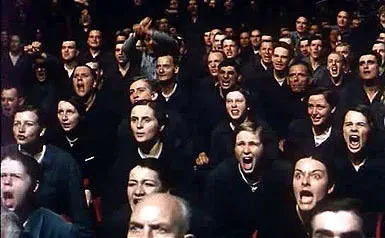
“The horrible thing about the Two Minutes Hate was not that one was obliged to act a part, but, on the contrary, that it was impossible to avoid joining in… A hideous ecstasy of fear and vindictiveness, a desire to kill, to torture, to smash faces in with a sledge‑hammer, seemed to flow through the whole group of people like an electric current.”38
X under Musk shows direct parallels to the Party: suspending critical journalists, throttling links to outlets that publish unfavourable stories, suing independent researchers, demanding that advertisers and the public reject empirical findings to protect the platform’s reputation. His “free‑speech absolutism” is contradicted by the platform’s practice. Under his ownership X has welcomed back Holocaust deniers, white supremacists and election deniers, while Musk remains exquisitely sensitive to criticism of himself, his allies or his companies.
Musk’s goal was never an open forum for the res publica. It was to turn Twitter into a centralised environment where his allies and favoured intolerant narratives flourish and dissent is punished — a privatised Ministry of Truth run for Musk and the extremist wing of the GOP, now with its own AI, Grok, to help. We return to this, and to the paradox of tolerance, in Part 2.
“The Party told you to reject the evidence of your eyes and ears. It was their final, most essential command.”
Techno‑Villain or Tragically Flawed Anti‑Hero? #
I know I am guilty of polemic — of putting language into battle. If I use strong assertions on circumstantial evidence, it is because some dangers are serious enough that we must enlist the English language to fight them, especially when the media offer a malaise of even‑handedness that is usually cowardice, appeasement or facilitation of the powerful. The truth is of course more nuanced, even about Musk and Trump, though their essential corruption is plain.
“The fault, dear Brutus, is not in our stars, / But in ourselves.”39(Cassius)
Some will read Musk as a tragic hero undone by hubris. He misreads Tolkien and Herbert — the One Ring, the messianic betrayal — because he believes he is the sole exception who can wield universal forces without corruption. I don’t buy it. His talk of saving civilisation from “suicidal empathy” is pseudo‑intellectual scaffolding for actions that destroy empathy, amplify hate and align him with the pitiless authoritarianism this literature warns against. A man who claims to have done more for the environment than anyone alive, then spends hundreds of millions funding a movement committed to destroying climate action, is not a tragic hero. He is a catastrophic, immature and dangerous failure.
The most flattering reading is the anti‑hero: worthwhile ends through destructive means. We can concede the marvels — the acceleration of EVs, the revolution in launch costs — and condemn the moral decay that came with them. Musk asks us to judge the ends and treat the concentration of wealth and the abuse of political influence as a necessary phase. That is self‑serving rationalisation, and I don’t care for it either. Utopian goals pursued by dystopian means have always ended in great suffering; they are incompatible with the humanist spirit and they will lead civilisation to ruin.
Musk is neither hero nor Antichrist, though he has moved towards outright villain. Yet I must remind myself that humans are made imperfect without being wholly corrupted, and that even those who seem irredeemable are not always lost to the chance of grace. I have not given up hope that Elon Musk may see the light again, even briefly, before he dies.
Don’t you and I, dear reader, also need such grace in our lives?
“Hail Mary, full of grace… Pray for us sinners, Now and at the hour of our death.”
Masked Crusader or Crusader Behind a Mask? #
Musk sees himself as a hero, perhaps a real‑life caped crusader. The key to Batman — my favourite hero, and many people’s — is that he is only a man: hardened by darkness, strong, just, but mortal and vulnerable.
Musk is the other thing: the crusader behind the mask.
“The First Crusade… set off on its two‑thousand‑mile jaunt by massacring Jews, plundering and slaughtering all the way from the Rhine to the Jordan.”40 (Herbert J. Muller)
The Crusades (1095–1291) were ethno‑religious supremacy in arms. Encouraged by the Pope and first prosecuted by zealots41 promised remission of sins for lives of violence and greed, they were followed by waves of nobles after trade, land and plunder, dressed as Christian necessity. The dead ran to millions. The Rhineland communities of Worms and Mainz were massacred and forcibly converted;42 when Jerusalem fell in 1099 its Muslim and Jewish inhabitants were slaughtered.
“Two days later not a single Muslim was left alive within the city walls.”43 (Amin Maalouf)
These dark urges, once unleashed, are not easily controlled. In 1204 the Fourth Crusade turned on Christian Constantinople and sacked it; Nicetas Choniates records Crusaders defiling churches and raping nuns.
“The Crusades — the most signal and most durable monument of human folly that has yet appeared in any age or nation.”44 (David Hume)
Do we really want to go back to centuries of violence based on religion and ethnicity?
Musk’s actions mirror the crusading hypocrisy: speaking of saving civilisation while spreading the hate virus, funding political violence and pillaging the public square he seized. His obsession with rape, while supporting an administration led by a man found liable for sexual abuse, is cognitive dissonance of a high order.45 He is less a flawed protector than an agent of control and chaos, using immense technological power for domination rather than liberation.
Elon Musk is the walking, talking embodiment of the literary warnings he fails to comprehend.
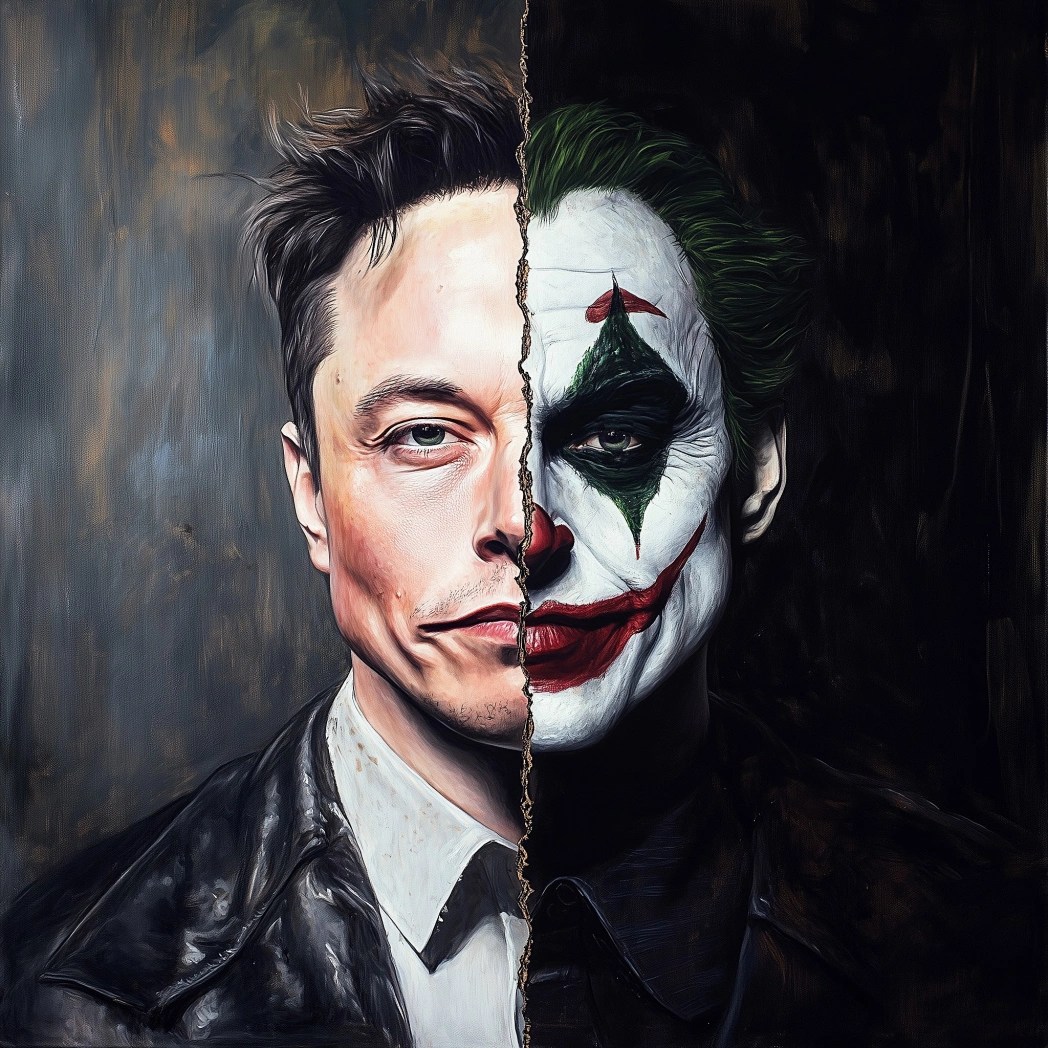
He is a Paul Atreides blind to, or arrogant about, the jihad his wealth is unleashing — and Muad’Dib at least had humility and good intentions. He is Saruman, a wizard who has lost his grounding (humility literally means of the earth). He is a Wizard of Oz whose magic is smoke and mirrors. At times he is the Joker, assuming everyone is as damaged as he is.
“He is not a scientist, he is not an engineer. He is a billionaire con man with a lot of money.”46 (Alexandria Ocasio‑Cortez)
Depending on your perspective Musk is the villain or the anti‑hero our times produced. Only God knows whether we deserve him. Whatever he is, he is not the one we need.
In Part 2 we look at Musk as a self‑proclaimed champion of free speech: The Limits of Free Speech & the Paradox of Tolerance.
Footnotes #
Edward Helmore, ‘Elon Musk’s father accused of sexually abusing his children and stepchildren’ ↩︎
Brianna Morris-Grant, ‘Elon Musk’s father, Errol Musk, accused of abusing five of his children over three decades’ ↩︎
Sartre, ‘Essays in Aesthetics’ ↩︎
Federal Election Commission filings; Musk gave more than $290m in the 2024 cycle, including $216m to America PAC. He has since pledged at least $100m to Republican committees for the 2026 midterms, which the GOP lost in the House on 3 November 2026. ↩︎
“DOGE froze billions of dollars in federal grant funds and led “large-scale reductions in force,” firing or placing on leave tens of thousands of federal employees."(American Oversight). ↩︎
People v. Trump, Manhattan Supreme Court, 30 May 2024 (34 counts of falsifying business records); Carroll v. Trump, S.D.N.Y., May 2023 and January 2024 (jury found Trump liable for sexual abuse and defamation). ↩︎
Noam Chomsky quoting Norman Ornstein, ‘De-Americanizing the World’ ↩︎
In an obvious miscarriage of justice (due to home advantage) Musk defeated the defamation claim by Unsworth. ↩︎
James Lovelock, ‘Novacene: The Coming Age of Hyperintelligence’. ↩︎
[Henry Maher, ‘The Conversation’](https://theconversation.com/elon-musk-now-has-an-office-in-the-white-house-whats-his-political-game-plan-248011) ↩︎
https://www.presidency.ucsb.edu/documents/message-congress-curbing-monopolies ↩︎
Julia Carrie Wong, ‘Loathe thy neighbor: Elon Musk and the Christian right are waging war on empathy’ ↩︎
Alan Travis, ‘UK axes support for Mediterranean migrant rescue operation’ ↩︎
Elisabeth Young-Bruehl, ‘The capacity for evil can spread like an epidemic’ ↩︎
Wikipedia, “Paul Atreides’ ↩︎
Katherine Alejandra Cross, ‘Elon Musk’s Artificial God’ ↩︎
Carolin Amlinger & Oliver Nachtwey, ‘In Elon Musk, Libertarianism and Authoritarianism Combine’ ↩︎
Henry Maher, ‘The Conversation’ ↩︎
Vivian Jenna Wilson, ‘Teen Vogue’ ↩︎
John Semley, ‘Elon Musk Doesn’t Really Get The Lord of the Rings’ ↩︎
The Letters of J.R.R. Tolkien, 1981. ↩︎
J.R.R Tolkien, ‘Letter to Eileen Elgar’ ↩︎
James Ball, ‘Lord of the Wrongs: What Musk gets wrong about Tolkien and Orwell’ ↩︎
Stuart Jeffries, ‘A Man of Culture’ ↩︎
Stuart Jeffries, ‘A Man of Culture’ ↩︎
Elon Musk, Twitter, 2018. ↩︎
Iain M. Banks, ‘Consider Phlebas’ ↩︎
Iain M. Banks, ‘Use of Weapons’ ↩︎
‘Understanding Contemporary American Science Fiction: the Formative Period ‘, Thomas Clareson, 1992. ↩︎
Commandment in the Orange Catholic Bible, Dune. ↩︎
George Orwell, ‘Facing Unpleasant Facts’ ↩︎
George Orwell, ‘1984’ ↩︎
Shakespeare, ‘Julias Caesar’ ↩︎
Herbert J. Muller, quoted in Peters, L. J. ‘Peter’s quotations: Ideas for our time ‘, 1977 ↩︎
Professor Jonathan Phillips, ‘Motivations of the First Crusaders ' ↩︎
Amin Maalouf on the 1099 breach of Jerusalem, ‘The Crusades Through Arab Eyes”. ↩︎
David Hume, ‘The History Of England’ ↩︎
Notebooklm: Epstein – The Intelligence Asset, Sexual Abuse & Criminal Corruption ↩︎
Yahoo finance, AOC Rips Into Elon Musk ↩︎