Elon Musk – Part 3: The Death Star
We watch in horror as the Empire of The Dark Enlightenment grows
“Blame it on the black star Blame it on the falling sky Blame it on the satellite…” 1(Radiohead)
In Part 2 we examined X, Grok and Grokipedia, and Musk’s manufacture of disinformation and hate. Now, in the final act, we face the culmination of the arc, playing out in real life.
“Words are wise men’s counters… but they are the money of fools.”2 (Thomas Hobbes)
We have established the deep failure of Musk’s moral imagination: his descent from self‑proclaimed ecological crusader to financier of authoritarianism; a zealous crusader behind a mask who weaponises “free speech” to build a privatised Ministry of Truth. He is part of a new order constructing a digital panopticon in which each person is atomised, sanitised or radicalised, shouting into the void, many unaware of the bars that hold them, some even believing that safety requires everyone to be surveilled.
This Part moves from ideology to structure: the interconnected infrastructure our real‑life villain is building to consolidate his and his allies’ power. And it is to the Star Wars universe, quelle surprise, that we turn for the symbolic heavy lifting.
October 2026: The Veto Is Used #
For three years the risk was hypothetical. We knew that in September 2022 Musk had refused to extend Starlink coverage to Crimea for a Ukrainian drone attack, and Reuters later reported that he ordered coverage cut over parts of Kherson during the autumn counteroffensive, forcing a retreat whose communications had been severed.3 Those were deniable: a terms‑of‑service question, a fog‑of‑war story.
In early October 2026 there was no fog. Musk throttled Ukraine’s access to Starlink and to Starshield — the military variant on which Ukrainian drone warfare and command now depend. The restriction lasted about a week. Ukrainian units reported battlefield interruptions as Russian missile strikes intensified.4 When he lifted it, Musk said he had imposed it because Ukraine had used the network for offensive rather than defensive operations, in breach of SpaceX’s terms.5 On 1 November he went further, threatening to terminate service in Ukraine entirely, accusing the country of using Starlink “for drone strikes to kill people”, and noting — accurately — that the front line would collapse immediately if he did.6
Read that again. A private individual, the richest in history, publicly stated that he could collapse the front line of a European war at will, and that he was considering it. That is not a company. That is a sovereign, and a volatile one.
Europe’s position is exactly as weak as this series warned. Eutelsat has about 600–700 active satellites to Starlink’s 10,000‑plus; its terminals are five times the price and too large to mount on small drones.6 SES has around a hundred; Hisdesat two. The EU’s €10.6 billion IRIS² constellation will begin launching in 2029 and reach full service around 2030–32, with a few hundred satellites.7 GOVSATCOM, the stop‑gap the Commission is urging on Kyiv, cannot be used for warfighting.6 Even with €8 billion, experts say, Europe cannot field a functional replacement before the early 2030s.6 The honest options in the meantime are mesh radio, fibre‑optic drones and praying that one man’s mood holds.
“If, in the current war or some future war, Musk decides to align against Europe and throttles or yanks Starlink and Starshield, countries will be left scrambling.”8 (CEPA, November 2026)
What follows explains how this came to be possible, and why Starlink is only one limb of the beast.
The Empire Grows Stronger #
Musk’s companies — SpaceX including Starlink and Starshield, xAI including Grok, Neuralink, and Tesla’s robotics and computing — must be seen as a single technological empire allied with neo‑reactionary businessmen and authoritarian leaders around the world. Valued collectively at well over $1.5 trillion, the ecosystem has shown an unprecedented capacity for self‑reinforcement. It is also a public‑private partnership: an outsourced agent, primarily of US political and military interests, but available to any authoritarian who shares its methods.
The anti‑enlightenment ideology is being hard‑coded into the stack:
- Privatised Ministry of Truth — X, Grok, Grokipedia
- Communications surveillance and denial of service — SpaceX, Starlink, Starshield
- Bio‑structural inequality — Neuralink
- Robotic labour displacement — Optimus
These technologies are intended to secure the dominance of a technological elite over the unenlightened organic masses.
The Dark Enlightenment #
This architecture is not merely a corporate strategy. It is the manifestation of a political theory known as the Dark Enlightenment, or neo‑reaction (NRx) — the new tech face of old‑school fascism, advocated by Peter Thiel and embraced in substance by Musk.9 It supplies the intellectual scaffolding for the assault on national and personal sovereignty, and it has the great advantage of being publicly quotable, unlike the Stalin and Hitler precedents these men have clearly also studied.
Its founders, Curtis Yarvin and Nick Land, cite Hobbes. Hobbes argued that only a single, monolithic sovereign — the Leviathan — could prevent the war of all against all. For NRx this becomes a technological mandate: democracy is to be replaced by an unaccountable state run like a corporation by a single CEO, and individuals surrender nearly all rights to an absolute sovereign. As Thiel put it: “I no longer believe that freedom and democracy are compatible.”10 The principle justifies every consolidation of control — from X censoring critics to Starlink acting as a military veto — as a necessary means to “preserve civilisation”, Musk’s constant refrain.
The programme also envisages authoritarian capitalist city‑states competing for citizens, which maps precisely onto Musk’s vision of a self‑governed, non‑democratic Mars colony. The depopulated ruins of Gaza may be a first candidate.11 NRx espouses scientific racism and dominance hierarchies; Musk’s alignment with ethno‑nationalist figures is not posturing but consistency with an ideology that regards diversity and empathy as weaknesses to be purged. We know the song. We did not expect to hear it sung so loudly less than a century after Berlin.
What Hobbes actually said #
“Rulers use philosophers much as drunks use lamp‑posts: for support, not illumination.”12
As with the novelists in Part 1, Musk’s fraternity borrows from Hobbes only what justifies them and discards the ethical heart. Hobbes held that people give up invasive rights — liberties that let one person harm another — and in return take on duties not to hinder others. But not all rights are alienable. The motive for the covenant is self‑preservation, so every individual retains an absolute right to resist anyone who assaults, enslaves or imprisons them — “Wounds, and Chayns, and Imprisonment”. A sovereign who acts outside those boundaries loses legitimacy, because the sovereign was created to protect each member from the predation of the others.
In the modern context the surrender of rights is not a one‑time covenant but a continuous exchange: autonomy, privacy and data traded for digital services. Starlink mediates communication; Grok shapes the interpretation of reality; Neuralink aims at the body itself. This new Leviathan does not rule a territory. It manages the foundational infrastructure of modern life — information, communication, intelligence — and so acts as an inescapable digital sovereign. By Hobbes’s own test it has already forfeited legitimacy.
Kingmakers on the public purse #
These men have been called kingmakers,13 and they are also the private arm of the power behind the throne. Musk’s companies have received at least $38 billion in government contracts, loans, subsidies and tax credits, often at critical moments.14 Palantir was seeded by the CIA through In‑Q‑Tel and lives on state contracts, including the NHS. SpaceX could not operate without NASA and Pentagon money. Anduril’s autonomous weapons are bought almost entirely by the US military. The Leviathan’s body extends from and into government, which gives it freedom of action no mere market actor enjoys.
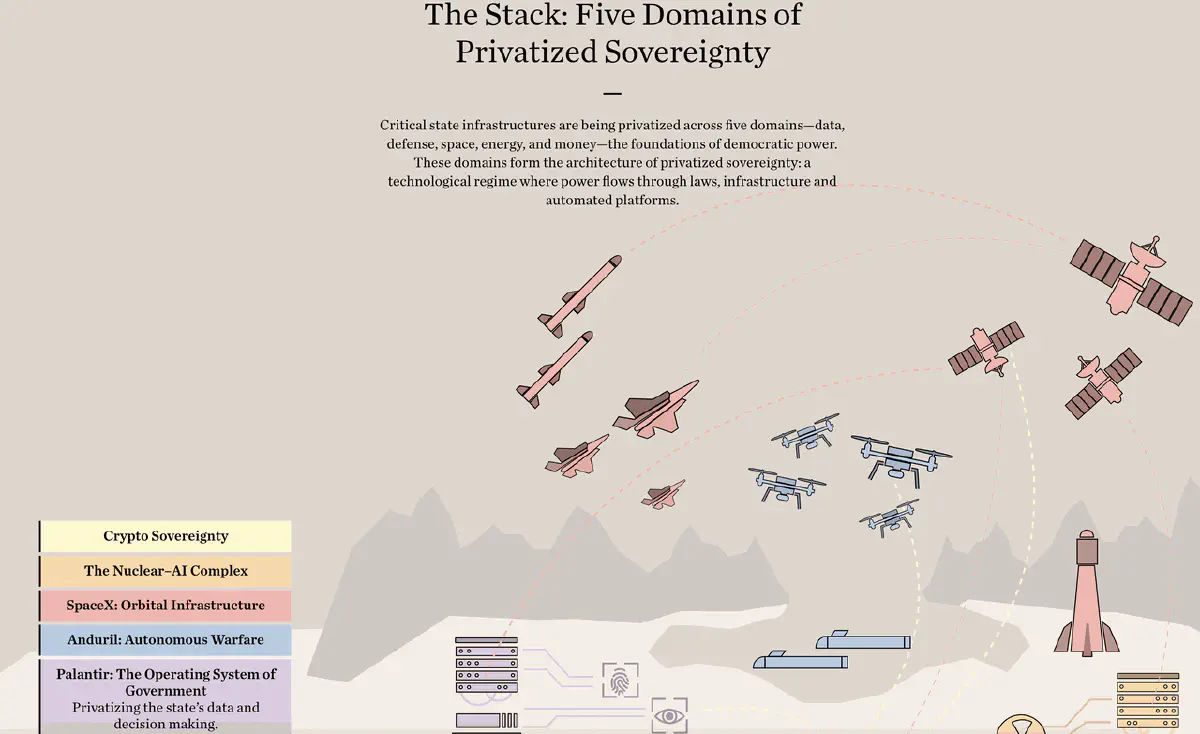
“Critical state infrastructures are being privatized across five domains — data, defense, space, energy, and money — the foundations of democratic power. These domains form the architecture of privatized sovereignty.”15 (Francesca Bria, The Authoritarian Stack)
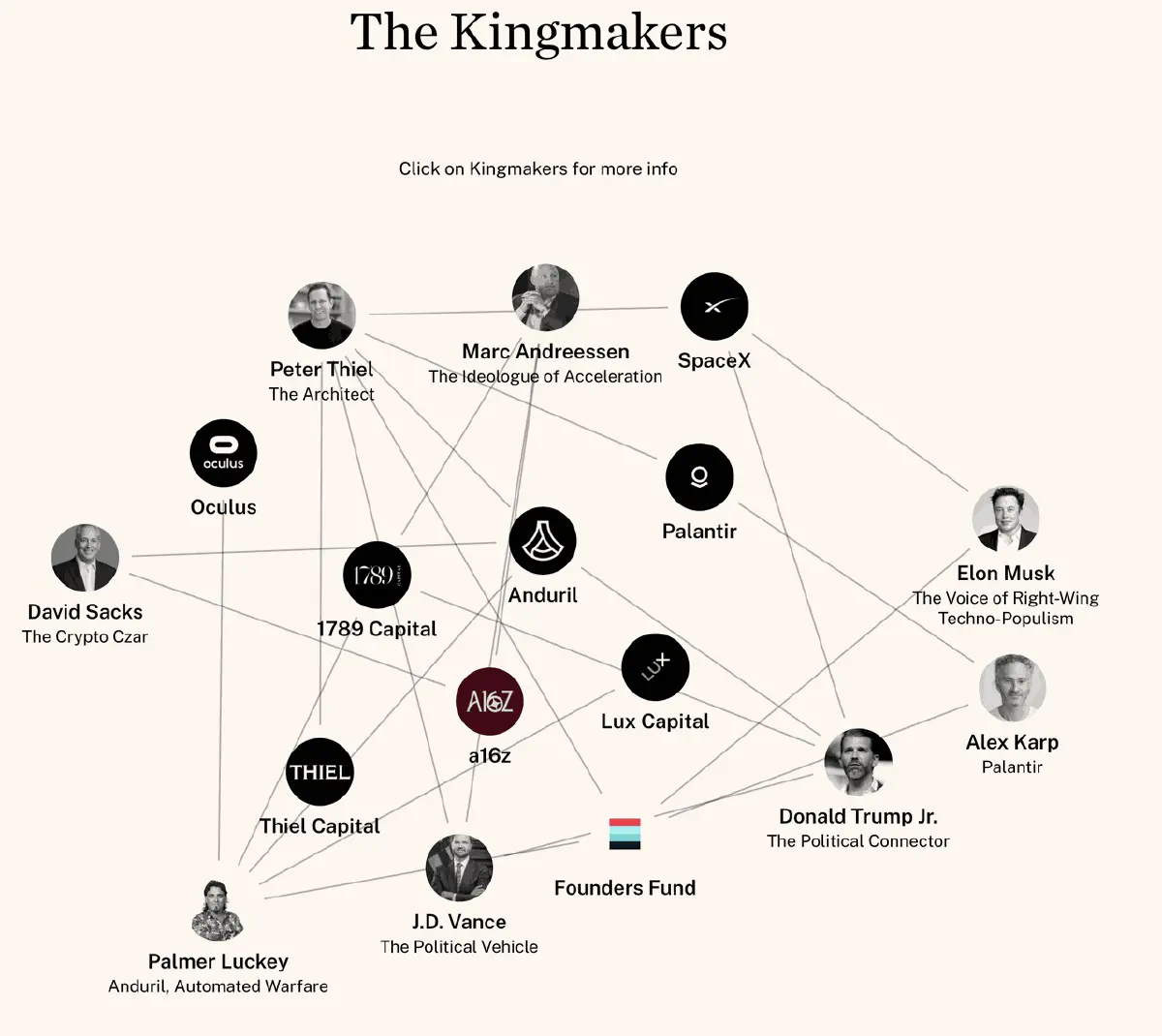
What emerges is corporate strategic autonomy: a private fiction wielding command over domains reserved for states, operating by design outside the regulatory and geopolitical constraints that bind smaller states, let alone companies. This explains the abject UK ministerial suggestion that “humility” is needed before such men. The question for Europe is existential: can its strategic autonomy, its democratic values and its way of life survive a frontal assault by a hybrid techno‑plutocrat allied to an authoritarian US government?
Leviathan Inc. #
“Better to reign in Hell, than serve in Heav’n.”16(Milton)
Musk is not a man who owns a social‑media platform. He controls an integrated, multi‑industry empire with a concentration of power unprecedented in the private sector, and he has decided he would rather reign in the Hell he is helping to make. The fusion of government backing, corporate power and populist strategy lets him operate outside regulators and courts with an oligarch’s conviction that the law is for losers. He attacks traditional media and politicians17 while casting himself as the semi‑mythological hero leading humanity to the sunlit uplands of truth — defined by him and his billionaire friends.
“Glad you ditched the license — many are opting out for that reason. Defunding the BBC would end the mandatory subsidy for biased content, letting viewers choose truly impartial sources like GB News or independents.” (Grok, to a user)

“I must create a System, or be enslaved by another man’s.”18 (William Blake)
SpaceX and Starlink: control of the sky #
The digital threat is amplified by physical dependency. Starlink and SpaceX are the most profound and immediate security risk Europe faces, because of the leverage they give one man. Musk controls roughly two‑thirds of all active satellites in orbit — more than 10,000 Starlink units, with a licensed ambition of 42,000. The EU relies on SpaceX to launch its own satellites and telescopes. Starlink is the backbone of connectivity for tens of thousands of Europeans and, as we have seen, of Ukraine’s war.
Security analysts describe the expansion as technological imperialism: it allows the harvesting of sensitive data and can effectively deny other nations the peaceful use of orbit.19 It is also a GDPR and NIS2 problem. Starlink does not disclose where EU user data is routed and gives no enforceable commitment that it stays within the Union; data may downlink in third countries beyond the GDPR’s reach, a systemic risk flagged by ENISA. As a US company SpaceX is subject to the Cloud Act and CALEA wherever the data sits, a conflict with EU law it shares with Microsoft, Google and Apple.20
And here is the trap, which October 2026 sprang. Aggressive regulatory action against X — maximum DSA fines, structural remedies — carries the risk that Musk retaliates by degrading or withdrawing launch and communication services essential to European defence. Europe cannot credibly impose maximum pressure on Musk until it has sovereign space communications of its own. Poland said in 2025 it would seek alternatives for Ukraine if Musk proved unreliable. He has now proved it. The alternatives do not yet exist.
Starlink is a security and GDPR threat to Europe. It does not publicly disclose where user data is routed, nor does it provide a binding, enforceable commitment that data from EU users will remain within the Union. — Peter Pink‑Howitt, Bluesky, 30 October 2025
What Europe must do #
The EU is now pursuing what Politico describes as a five‑front strategy: an industrial rival, reshaped spectrum access, its own constellation, alternative communications for Ukraine, and additional regulatory obligations under the forthcoming EU Space Act.21 All of it is necessary; none of it is fast. Three things would help now.
- Treat IRIS² as defence procurement, not an industrial programme. Fund it fully, accelerate it, and stop member states hedging with national systems (SATCOM Bw, Syracuse IV) that fragment the effort.7
- Buy Eutelsat/OneWeb capacity and terminals for Ukraine now, at scale, even though it is inferior, because a second network that cannot be switched off by one man is worth more than a better network that can.
- Write a switch‑off clause into every public contract with SpaceX. No launch, no Starlink and no Starshield contract with a European government should lack a term treating unilateral service degradation as a sanctionable breach with pre‑agreed penalties — and the Commission should make Starlink’s conduct in Ukraine a factor in its market‑access decisions.
I, Robot #
“You must be the dumbest smart person in the world.”22 (I, Robot, 2004)
Tesla’s humanoid Optimus is a general‑purpose robot for “tasks humans don’t want to do”. Musk expects it to outgrow the car business and become “the biggest product of all time”. It will be governed by Grok and shares a proprietary core with Tesla’s self‑driving software. Its explicit purpose is the replacement of human labour, with a long‑term target of a million units a year before 2030.
Earlier analysis put the jobs displaceable by automation at up to 800 million worldwide by 2030; the real problem is the gap between where jobs vanish and where they return, and between the skills workers have and the skills new roles need.23
Asimov’s “Runaround” (1942) gave us the Three Laws of Robotics and showed a robot trapped in a loop when the laws, tweaked for a particular task, come into conflict.24 Musk, in his usual fashion, will have inhaled I, Robot and concluded that the lesson is to build a robot army enslaved to him, with the Laws heavily tweaked or abandoned. I am an AI optimist in the long run. An army of MechaHitler‑Grok robots is not what any sane person wants.
The wider industry’s willingness to loosen safety guardrails for engagement — the lawsuits over ChatGPT’s role in two suicides are the grimmest example25 — shows the pattern is not unique to Musk. It is a system that prioritises profit over life. But in Musk’s hands, Grok is a weapon of mass misinformation and Grok‑powered robots are potential weapons of mass destruction. Musk himself says AI is more dangerous than nuclear weapons. He is right, and he is the wrong man to hold it.
The integration of cognitive AI (Grok) with physical platforms (Optimus) and dual‑use communications (Starlink/Starshield) creates real uncertainty about control and escalation if any of it is folded into lethal autonomous weapons — which, as Part 2 of the drones essay showed, is the direction of travel.
xAI and the race to AGI #
“AI will not replace humans, but those who use AI will replace those who don’t.”26
xAI is bound to the rest of the empire by a $2 billion investment from SpaceX and by Tesla’s data. Its Colossus supercomputer, which Musk calls the world’s largest, trains Grok on the monopolistic data of seven million Tesla vehicles, the firehose of X, and now Grokipedia. During Musk’s months at DOGE, Grok was reportedly used inside government to process sensitive federal data, automate job cuts and monitor federal workers for anti‑Trump or anti‑Musk language — a private AI operating inside a state function, exactly the systemic risk the EU AI Act exists to prevent.
“It was immediately obvious that hundreds of thousands of people would die in the first year alone. But the Administration did not reconsider; it escalated. Elon Musk exulted in swinging his chainsaw.”27 (Atul Gawande, on the dismantling of USAID)
The primary risk from xAI is an accelerated pursuit of AGI without guardrails, by a leader who has shown scant regard for law, democratic norms or individual human life, under competitive pressure to deploy first. The theoretical danger of AGI is already preceded by the demonstrated danger of a model whose safety layer has been deliberately weakened for commercial and political ends — Grok’s record of political bias, antisemitic tropes and praise of Hitler, catalogued in Part 2.
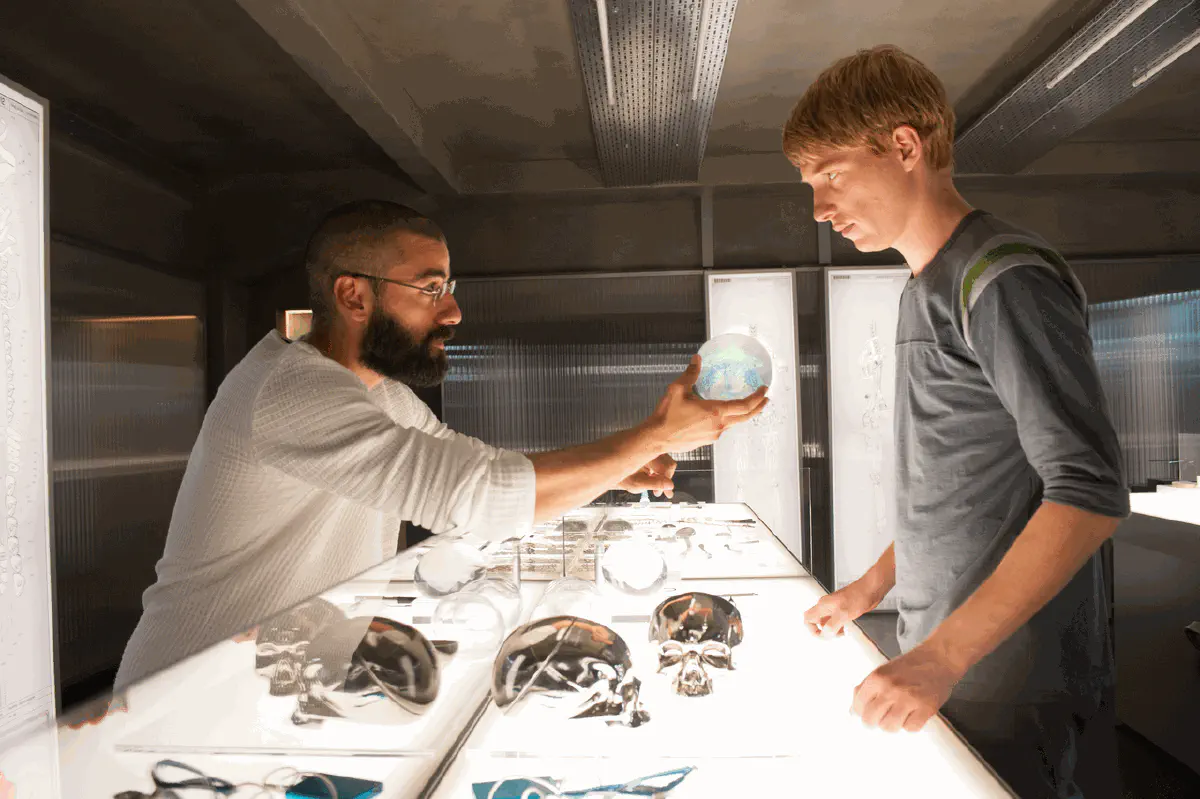
“NATHAN: Almost every cell phone has a microphone, a camera, and a means to transmit data. So I switched on all the mikes and cameras, across the entire fucking planet, and redirected the data through Blue Book. Boom. A limitless resource of facial and vocal interaction. CALEB: You hacked the world’s cell phones?”28 (Ex Machina)
Neuralink: the erosion of selfhood #
Neuralink aims first at medical rehabilitation — speech, sight — and has real regulatory momentum. It is also an explicit precursor to non‑medical cognitive enhancement: human‑AI “symbiosis”.29 That pivot replaces consensus medical ethics with goals set by corporate profit and, potentially, consumer control. NRx openly embraces eugenics through what Nick Land calls “hyper‑racism” — meritocracy and space colonisation as a genetic filter — and Neuralink is easily aligned with a programme of optimising minds for a hierarchical, wealth‑ and race‑based order.
A corporate AI with direct neural access is the ultimate tool of cognitive capture:
- Exploitation of thought. The brain becomes a proprietary data source looped back into Grok’s databases; surveillance, manipulation and advertising at a level where a user can no longer tell external influence from their own thoughts.
- Brain hacking. If the device is insecure, cognitive function itself becomes attackable.
- Ideological alignment. The AI could subtly reinforce the values of its owners, hard‑coding a worldview into cognition.
- The cognitive divide. An enhanced elite and an unenhanced majority — the NRx hierarchy made biological.
- Repression. Thought‑crime detection and enforcement are no longer metaphors.
- Unauditable decisions. A black‑box model in a private company, affecting minds, with no means of tracing bias to its root.
- Regulatory failure. No existing framework for privacy or mental integrity contemplates a device that reads and may write to the brain — and the man who controls it terrifies the regulators.
The confluence of corporate control, anti‑democratic philosophy and direct neural access risks the abandonment of personal autonomy itself.
The Death Star #
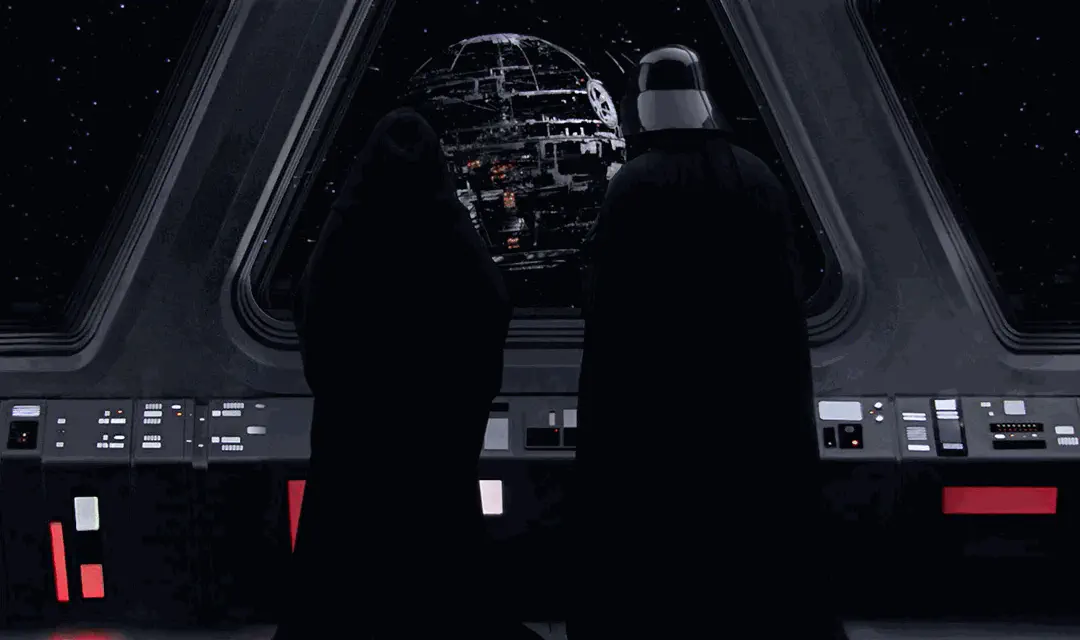
Musk’s integrated empire is a multi‑domain, systemic threat to every democracy. The infrastructure is operational and it is pointed at the foundations of self‑government, at cooperation between states, and at individual freedom. In scale and potential it is a Death Star.
In Star Wars the Death Star is the hubris of a technologically advanced empire: a totalitarian order sustained by absolute power, deception and fear; the worship of technology over nature and domination over cooperation; a moon‑sized deterrent that destroys planets. And yet it is also the symbol of the vulnerability of reliance on technology, and of fear over love and hope — because it is destroyed by a smaller, less advanced resistance of brave and intelligent people working together.
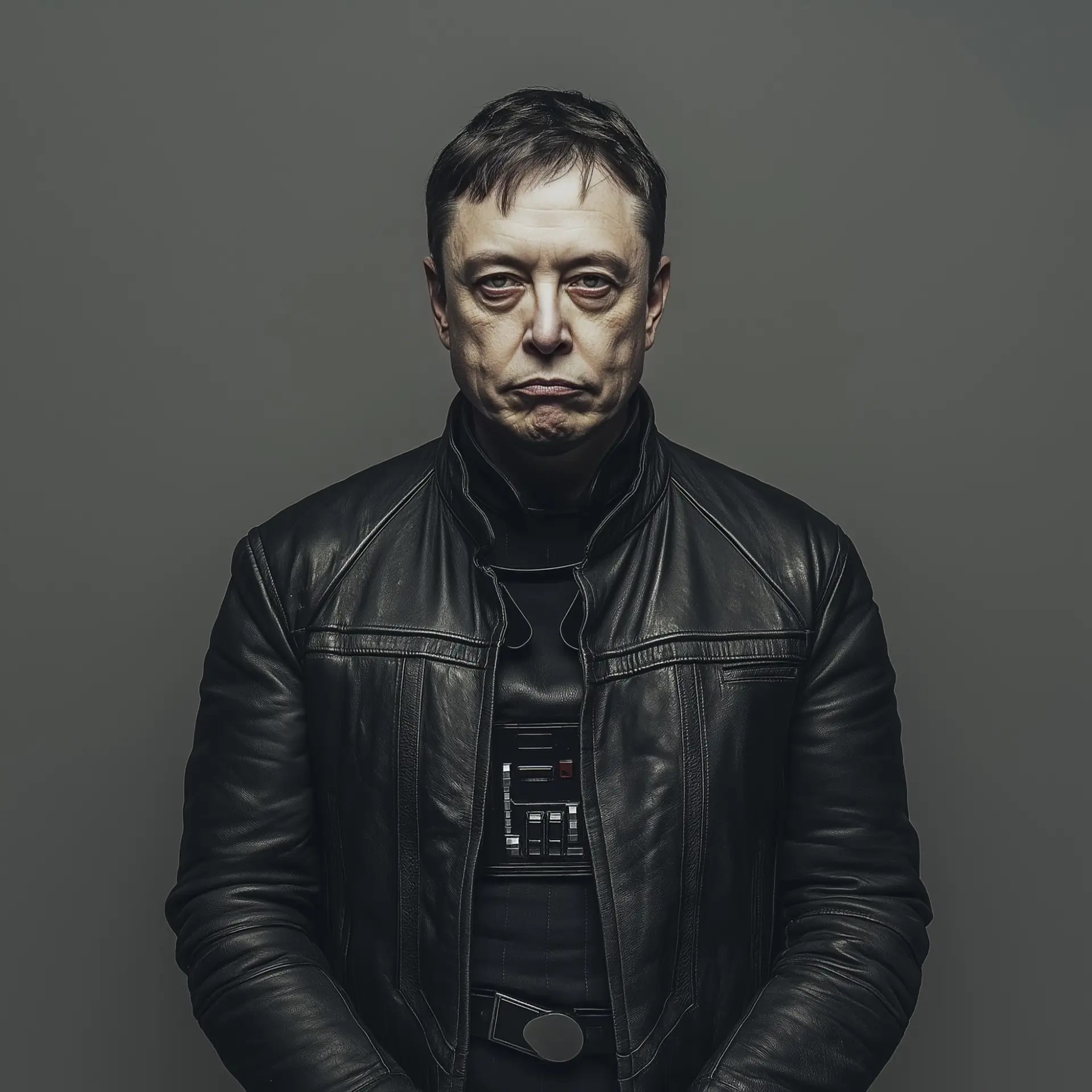
A while ago I illustrated an essay on Musk’s wars with EU and UK regulators with an AI image of him as a Sith Lord. It was not entirely satirical.
The choice was a warning. It was perhaps also a sub‑conscious, ungrounded hope that, like Anakin, Musk might one day recover his humanity — after doing great damage in our part of the galaxy, much like Vader.
In October 2026 the Death Star fired a warning shot. Elon Musk is now the greatest single danger to democracy, public discourse and the open society, and he has shown he will use the weapon. We must act accordingly — as journalists, politicians and regulators, and as parents and consumers.
Elon Musk is the Death Star. We must resist.
Footnotes #
Radiohead, ‘Black Star’(the meaning of the song is not relevant to this article but the words fit too well for this purpose) ↩︎
Walter Isaacson, Elon Musk (2023) on the Crimea incident, as corrected by Isaacson; Reuters, “Musk ordered shutdown of Starlink satellite service as Ukraine retook territory from Russia”, July 2025. ↩︎
Tech Insider, “Europe can’t swap thousands of Starlink terminals”, 15 October 2026; Ukrainian military statements on Starlink/Starshield interruptions, 14 October 2026. ↩︎
CEPA, “Europe: Get Satellites or Get Throttled”, 4 November 2026. ↩︎
Reporting collected at Ground News, “Why is Ukraine so reliant on Starlink and can Europe plug the gap”, 6 November 2026, including Musk’s 1 November post threatening termination and the Commission’s advice to Kyiv on GOVSATCOM. ↩︎ ↩︎ ↩︎ ↩︎
EuroProspects, “Only a Fully Backed IRIS² Can Deliver Europe’s Sovereign Alternative to Starlink”, 12 July 2026: 290–348 satellites, launches from 2029, service c. 2030–32; national programmes SATCOM Bw and Syracuse IV. ↩︎ ↩︎
CEPA, ibid.: Eutelsat under 700 satellites (1,300 planned by 2030); SES just over 100; Hisdesat two. ↩︎
Dark Enlightenment - Wikipedia. ↩︎
Peter Thiel, ‘The Education of a Libertarian’, 2009. ↩︎
Nafeez Ahmed, ‘Pro-Trump Tech Billionaires Are Poised to Cash In on Gaza’s ‘Peace’ Deal’ ↩︎
As my old history teacher, Mr Ashworth, wisely observed. ↩︎
The Authoritarian Stack: A project led by Prof. Francesca Bria with xof-research.org, ‘The Stack: Five Domains of Privatized Sovereignty’ ↩︎
Desmond Butler, Trisha Thadani, Emmanuel Martinez, Aaron Gregg, Luis Melgar, Jonathan O’Connell and Dan Keating, ‘‘Elon Musk’s business empire is built on $38 billion in government funding’’ ↩︎
The Authoritarian Stack: A project led by Prof. Francesca Bria with xof-research.org, ‘The Stack: Five Domains of Privatized Sovereignty’ ↩︎
Paradise Lost, I: 263 ↩︎
Paul Kirby & Laura Gozzi, ‘Europe leaders criticise Musk attacks’ ↩︎
Jerusalem, Plate 10 ↩︎
Yan Jiajie 严佳杰 & Yu Nanping 余南平, ‘The U.S. Starlink Project and Its Implications from the Perspective of International and National Security’ 国际和国家安全视角下的美国“星链”计划及其影响, 2024. ↩︎
Richard Speed, ‘Microsoft’s data sovereignty: Now with extra sovereignty!’ ↩︎
Politico, as summarised in “Europe Declares War on Starlink — Before Building an Army of Its Own”, 3 November 2026. ↩︎
A quote that could have been hand-crafted for Musk: ‘I, Robot’, 2004 – film based on a series of short stories by Isaac Asimov. ↩︎
Atul Kumar, ‘Why AI is replacing some jobs faster than others". ↩︎
Rob Kuznia , Allison Gordon & Ed Lavandera, ‘You’re not rushing. You’re just ready:’ Parents say ChatGPT encouraged son to kill himself’ ↩︎
Dominique A. Harroch & Richard D. Harroch, ‘15 Quotes on the Future of AI’. ↩︎
Atul Gawande, ‘The Shutdown of U.S.A.I.D. Has Already Killed Hundreds of Thousands’. ↩︎
‘Ex Machina’, film, 2014. ↩︎
Jim Reed and Joe McFadden, ‘Neuralink: Can Musk’s brain technology change the world?’ ↩︎