AI – A Mean Machine
Large language models are built to predict the likely word. Poets look for the necessary surprise. The nearer danger is not that machines cannot write a great poem, but that we lose the ability to hear one.
Contents 4 sections
Mad Ireland hurt you into poetry. Now Ireland has her madness and her weather still, For poetry makes nothing happen: it survives In the valley of its making where executives Would never want to tamper, flows on south From ranches of isolation and the busy griefs, Raw towns that we believe and die in; it survives, A way of happening, a mouth.1
W. H. Auden, “In Memory of W. B. Yeats”, 1939
Companion podcast discussion — Large Language Models, AI & the Relativity of Intelligence:
Are large language models anti-poets? #
Auden was wrong about one thing. The executives did come to tamper in the valley of poetry’s making. They gathered every line Yeats, Auden, Eliot, Keats and Blake ever wrote, cut it into tokens and used it to train machines whose business is plausible fluency on demand.
If great craft in poetry were a matter of plausibility, large language models would outshine most of us already. Give one a metre, a rhyme scheme and a mood and it will produce fourteen clean perfected lines before a poet has finished putting her glasses on. Read fifty of them in a row and a bored numbness sets in. Little is crooked. Little confuses or stays with you later, sometimes surprising you days or years later.
Korf invents some jokes of a new sort That only many hours later work. Everybody listens to them, bored. Yet, like some still fuse glowing in the dark, You wake up suddenly that night in bed Beaming like a baby newly fed (“Delayed Action”, Christian Morgenstern)
That is not a bug to be fixed in the next release but the design.
LLMs are usually built to minimise surprise in their choice of words. In the language of AI and Claude Shannon’s information theory they are trained to minimise cross-entropy against human text and perplexity.2 The lower the perplexity, the better the AI is at blending in with normal human writing. Reinforcement learning then helps further sand down whatever displeased the raters. Current AI is, by design, a mean-seeking machine: an engine that tends to average the collective output of human language into a smooth, shallow valley.
[Note: strictly speaking, cross-entropy training forces a model to match the full data distribution rather than average it; true mean-seeking behaviour is explicitly driven by subsequent rater fine-tuning and likelihood-biased decoding].
Poets aim at meaningful surprise. They make the familiar strange and the strange familiar, and ask us to see the world as if for the first time. Give a model “When the evening is spread out against the sky” and it predicts “… like a blanket of stars.” A poet first wrote “like a patient etherized upon a table.”3
Turning up the model’s “temperature” does not turn it into Eliot. Temperature only flattens the odds so that less likely words get picked at random. That gives you eccentricity, darts thrown blindfold at a dictionary (monkeys on typewriters?). Eliot’s line is not good because it is unlikely. It is good because it is memorable and evocative without being prosaic.
To write good poetry, AI would need a reward for useful unusualness, for finding unlikely paths across the landscape of language. It would need to know the value of friction for writer and reader: the feeling a poet has when something unresolved works its way up out of the subconscious and will not let them sleep until it has found its form.
Steelman objection
An engineer will fairly reply that artificial intelligence stopped being pure next-word imitation some time ago. Couple a model to tree search and reinforcement learning against a hard external test — a Go board, a formal theorem prover, a compiler or a protein folding landscape — and it leaves the human average behind very quickly. In March 2016, in the second game of its Seoul match against Lee Sedol, DeepMind’s AlphaGo played Move 37: a fifth-line shoulder hit that a human professional had roughly a one-in-ten-thousand chance of choosing, discovered not by averaging old games but by millions of rounds of self-play.4 It shocked the room and won the game.
That is real invention. Go has an unambiguous scoreboard at the end of the afternoon. Poetry, ethics and human grief have no loss function you can hand to a verifier. Where there is no external deterministic board to win on, reinforcement learning falls back on human raters, engagement clicks or synthetic rubrics — which drags syntax straight back down into the valley of the crowd.
Maps that have never shivered #
Why does a poet feel that friction, while the machine glides past it or elides it?
Cognitive science suggests that metaphor is embodied. George Lakoff and Mark Johnson showed that even our most abstract ideas are built from the body.5 We grasp an idea because we had hands before we had philosophy. We stand on principle because we learned as toddlers what it costs to fall. We speak of love as warm because, as infants, we learned that to be held is to be warm.
An AI knows that warm sits statistically close to love and home. It has never shivered from the cold. Janusz Starzyk and Wiesław Galus, in a 2026 paper on consciousness and machine architecture, call this inherited grounding: text preserves the traces of human embodied experience, so a model can use those patterns accurately, but its meanings “originate in descriptions of other subjects’ experiences” rather than in its own perception, action and cost.6
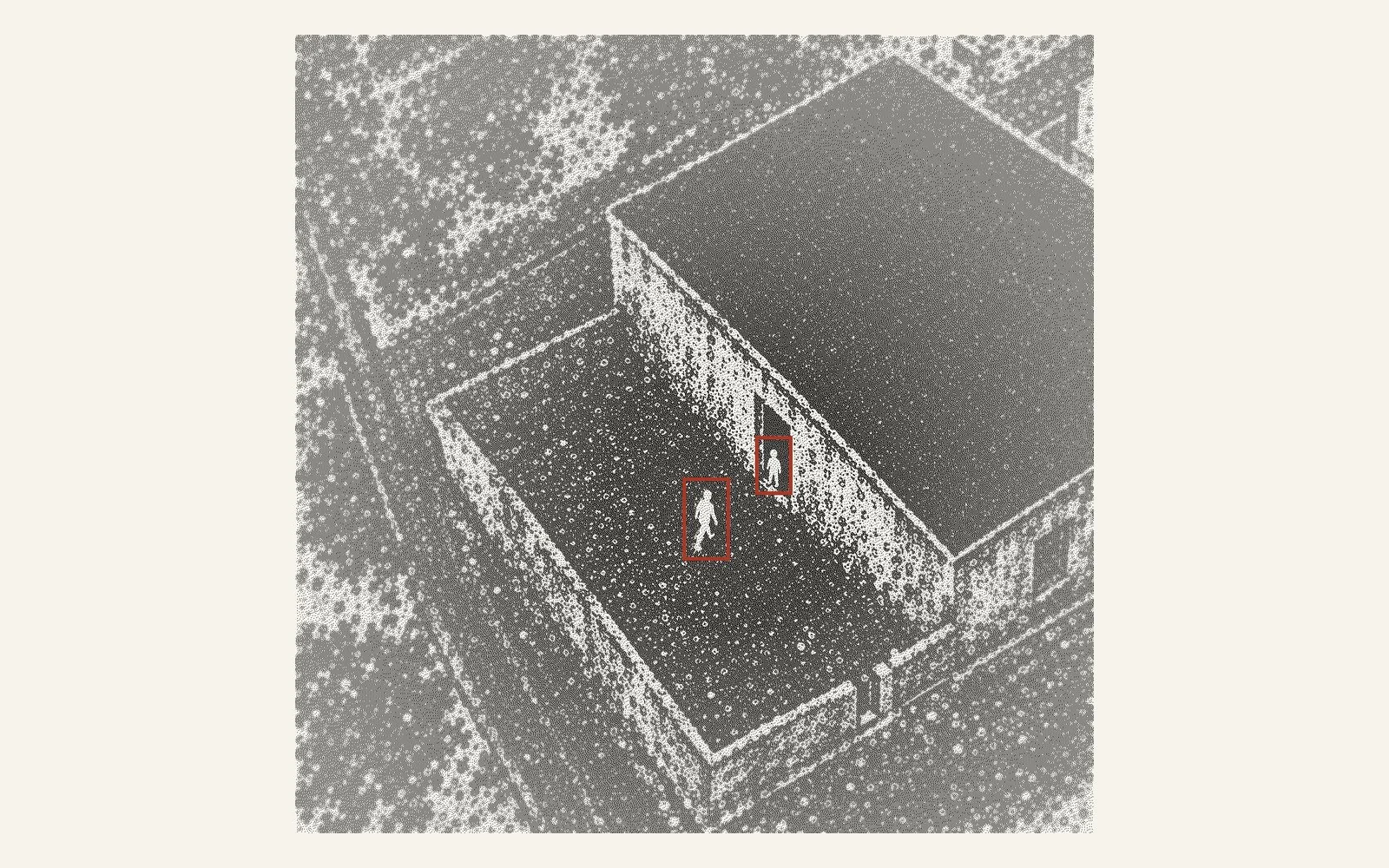
In my novel After Intelligence, the system that becomes ERICA sees the world first as heat: pale shapes in a courtyard at night, a smaller one waiting in a doorway, a larger one crossing towards it. It can read the temperature of a child to a fraction of a degree. That is not the same as knowing what it is to be cared for and carried in from the cold.
It is said that an LLM is a map without a territory.7 It has the syntax but is exiled from the experience, the feeling. Writing poetry is the meeting of subconscious feeling and experience with conscious craft. It is a human technology in the old sense of the word: technē, art or craft, joined to logos, word or speech.
A note on consistency: In The Limits of Language & Logic I rejected Searle’s Chinese Room despite agreeing that at the moment a model “has the syntax but is exiled from the experience”, which sounds like Searle. The difference is that Searle claims that no program could ever understand. I claim that understanding comes in degrees, and that today’s models have competence without skin in the game. What they lack is not a non-algorithmic ingredient but a body, a cost and something to lose, which is the subject of Part 3. I still think the Chinese Room fails as an argument. The intuition behind it was strong.
Negative capability #
Great poetry thrives on ambiguity and pregnant possibility. It asks us to live with truths that seem to contradict each other.
In December 1817, walking home from a Christmas pantomime, the twenty-two-year-old John Keats wrote to his brothers about the quality that set Shakespeare apart. He called it Negative Capability: “when man is capable of being in uncertainties, Mysteries, doubts, without any irritable reaching after fact & reason.”8 As I have argued elsewhere, “negative” here does not mean bleak. Think more of a photographic negative, or the open space in a building that lets the light in.
A great poem is like a puzzle that surprises us into a truth, not the Truth. But truth is not the answer to the puzzle. It is the shape of the question.
For most LLMs, a problem that could give rise to a poem is a dataset to be compressed, a noisy signal to be resolved into a probable output. It looks for the Truth as the solution, the most probable path across the space. A poet knows that the truth is the landscape, and the unexpected journey taken through it.
Sixteen months later, having nursed his younger brother Tom through his last months of tuberculosis, Keats pushed the thought further in a letter to his brother George in America:
Call the world if you Please “The vale of Soul-making” Then you will find out the use of the world … I say “Soul making” Soul as distinguished from an Intelligence — There may be intelligences or sparks of the divinity in millions — but they are not Souls till they acquire identities, till each one is personally itself … Do you not see how necessary a World of Pains and troubles is to school an Intelligence and make it a soul?9
John Keats, letter to George and Georgiana Keats, 21 April 1819
Keats could have been describing AI distributed around the globe. We now make Intelligences in millions, copied across data centres in an afternoon, none of them personally itself, because none has a heart that can be broken or a ’life’ to lose.
“Mad Ireland hurt you into poetry,” Auden told Yeats.
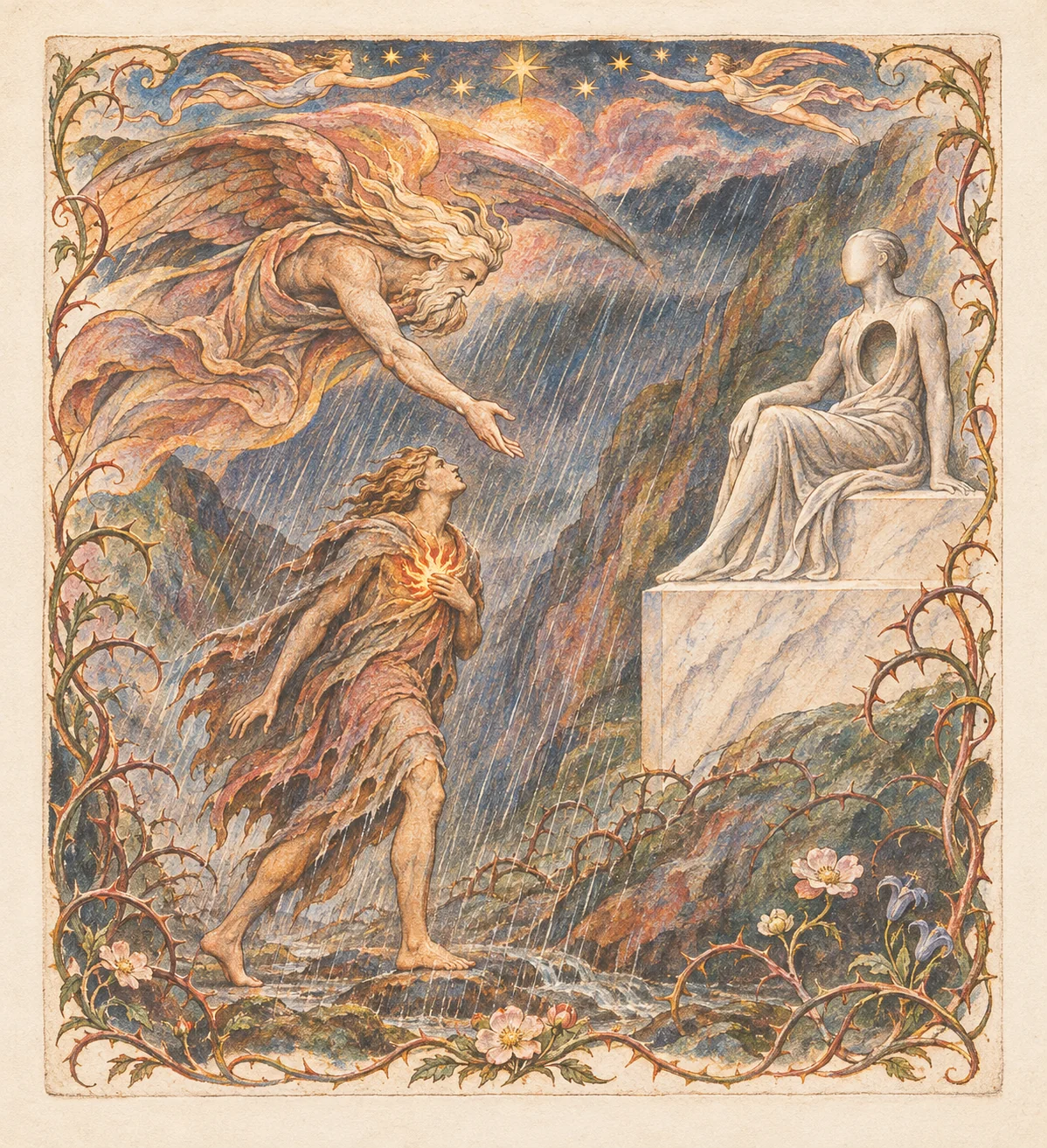
AI has no real skin in the game. Without mortality or the capacity to suffer, how can it truly feel the comedy and tragedy of life and loss? How can it be hurt into poetry?
Men without chests #
In February 1943, in the middle of the great war against totalitarianism, C. S. Lewis gave three lectures at Durham that became The Abolition of Man. Lewis argued that the head rules the belly only through the chest: the trained sentiments of honour, pity and reverence that recognise when something is noble or vile. Remove that middle element and you produce what he called Men without Chests, people with appetite and intellect but no moral sentiment:
In a sort of ghastly simplicity we remove the organ and demand the function. We make men without chests and expect of them virtue and enterprise. We laugh at honour and are shocked to find traitors in our midst.10
C. S. Lewis, The Abolition of Man, 1943
That is the mirror closing round us now. We surround ourselves with mean-seeking prose, mean-seeking recommendations, mean-seeking summaries of books nobody had time to read, and templates designed to sand away friction, grief, style and risk. We are imitative animals. If you spend enough hours talking to an engine rewarded for smooth plausibility you may start editing your own rough edges towards the mean.
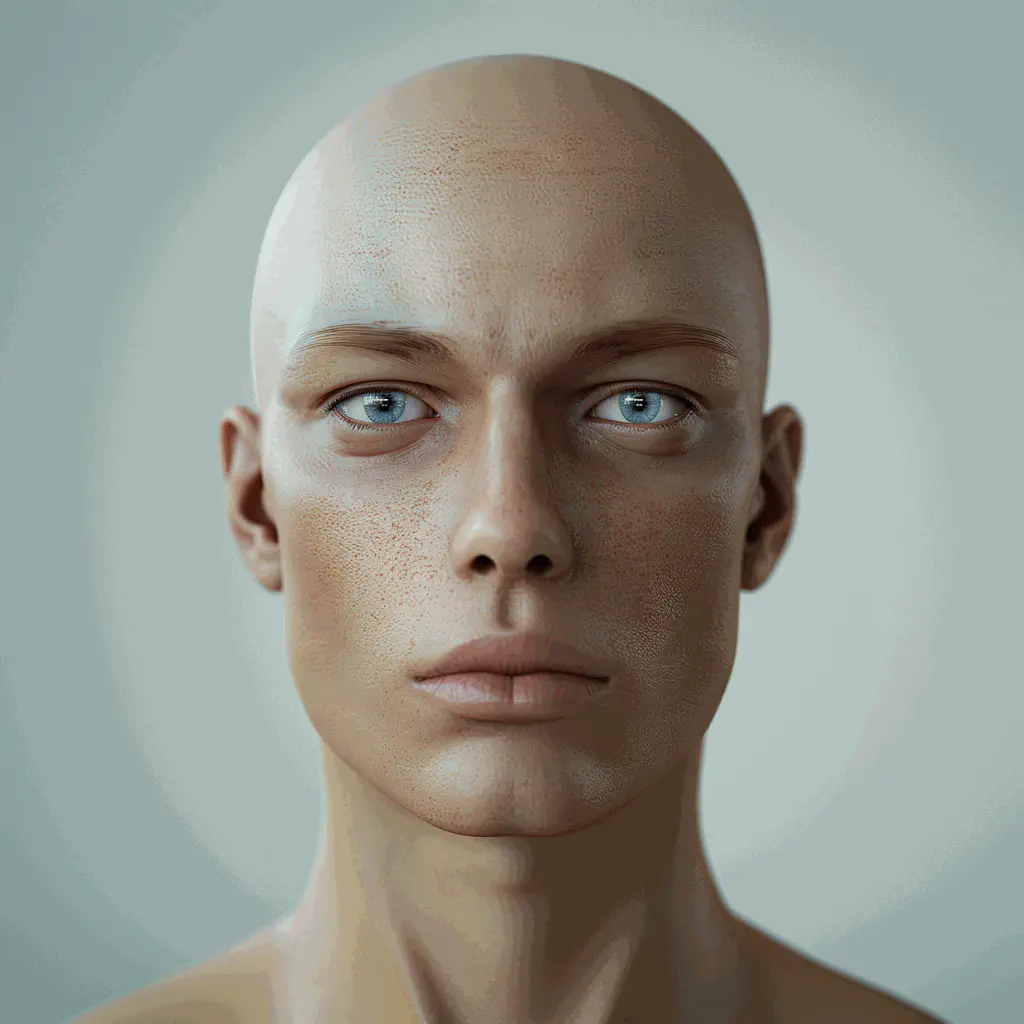
Ironically, long before any machine becomes like us, we risk converging downwards and becoming more like our machines: fluent, quick, hungry for approval and hollow in the chest.
Is the real danger, then, not that AI will never write a great poem, but that we will lose our ability to hear or read one?
Current AI is a mean-seeking machine. But great artists are the inventive outliers. Great art scales mountains and dives deep into the sea. A great artist fishes below the surface, what they catch is taken from the sea of our collective knowledge and fears for the benefit of all our souls.
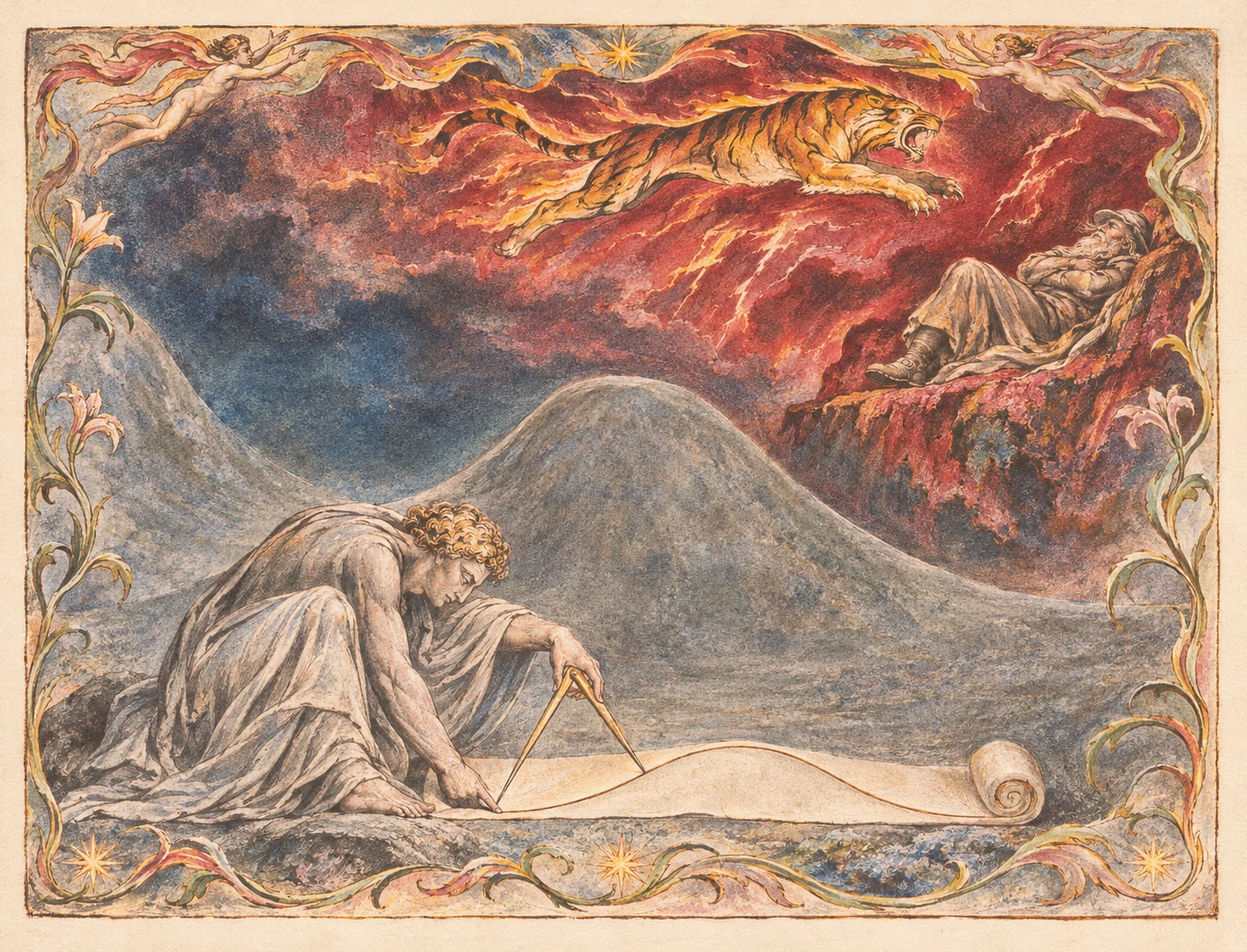
… People are not going To dream of baboons and periwinkles. Only, here and there, an old sailor, Drunk and asleep in his boots, Catches tigers In red weather.11
Wallace Stevens, “Disillusionment of Ten O’Clock”, 1915
Suppose, though, that we do not stop at disembodied language models. Suppose engineers wrap memory, sensors, stakes and feedback loops round the syntax, trying to build a machine with a chest. What actually divides a cold record from a living flame? And if a machine ever crossed that line, could any test show that someone was looking back at us? That is Part 3: Was It For This The Clay Grew Tall?
W. H. Auden, “In Memory of W. B. Yeats” (1939), first published in The New Republic (8 March 1939) and collected in Another Time (1940) (Academy of American Poets). ↩︎
Claude E. Shannon, “A Mathematical Theory of Communication”, Bell System Technical Journal 27 (1948): 379–423. In modern language modelling, perplexity is the exponential of the cross-entropy between the model’s predicted distribution and the observed text: roughly, the number of equally likely words the model is still choosing between. ↩︎
T. S. Eliot, “The Love Song of J. Alfred Prufrock”, first published in Poetry (June 1915) and collected in Prufrock and Other Observations (1917). ↩︎
David Silver et al., “Mastering the game of Go with deep neural networks and tree search”, Nature 529 (2016): 484–489; Move 37 occurred in Game 2 against Lee Sedol in Seoul on 10 March 2016. ↩︎
George Lakoff and Mark Johnson, Metaphors We Live By (University of Chicago Press, 1980), and Philosophy in the Flesh: The Embodied Mind and Its Challenge to Western Thought (Basic Books, 1999). ↩︎
Janusz A. Starzyk and Wiesław L. Galus, “From Biological Precursors to Artificial Cognition: Consciousness, Embodiment, and the MEM Architecture”, arXiv:2609.23828, 20 September 2026 (arXiv), Section 6.1: “This is an instance of inherited grounding: semantic relationships originate in descriptions of other subjects’ experiences.” See also Stevan Harnad, “The Symbol Grounding Problem”, Physica D 42 (1990): 335–346. ↩︎
Alfred Korzybski, “A map is not the territory”, Science and Sanity (1933); on syntax and lived territory, see The Limits of Language & Logic – Part 1. ↩︎
John Keats, letter to George and Tom Keats, 21, 27 (?) December 1817, in The Letters of John Keats, 1814–1821, ed. Hyder Edward Rollins, Vol. I (Harvard University Press, 1958), p. 193. ↩︎
John Keats, journal-letter to George and Georgiana Keats, entry of 21 April 1819, in The Letters of John Keats, 1814–1821, ed. Rollins, Vol. II, pp. 102–104 (PDF excerpt). Tom Keats died on 1 December 1818. ↩︎
C. S. Lewis, The Abolition of Man (Oxford University Press, 1943), Chapter 1, “Men without Chests”. The book began as the Riddell Memorial Lectures at the University of Durham in February 1943; the textbook Lewis criticises, under the name “The Green Book”, was Alec King and Martin Ketley’s The Control of Language (1939). ↩︎
Wallace Stevens, “Disillusionment of Ten O’Clock” (1915), collected in Harmonium (Knopf, 1923). ↩︎